Key points:
- A reinstall and a first-time install feel identical to the user, but the store can tell the two apart, since install history ties to an account, not just a download action.
- Neither Apple nor Google publishes a detailed breakdown of how a reinstall is weighted versus a first-time install in ranking.
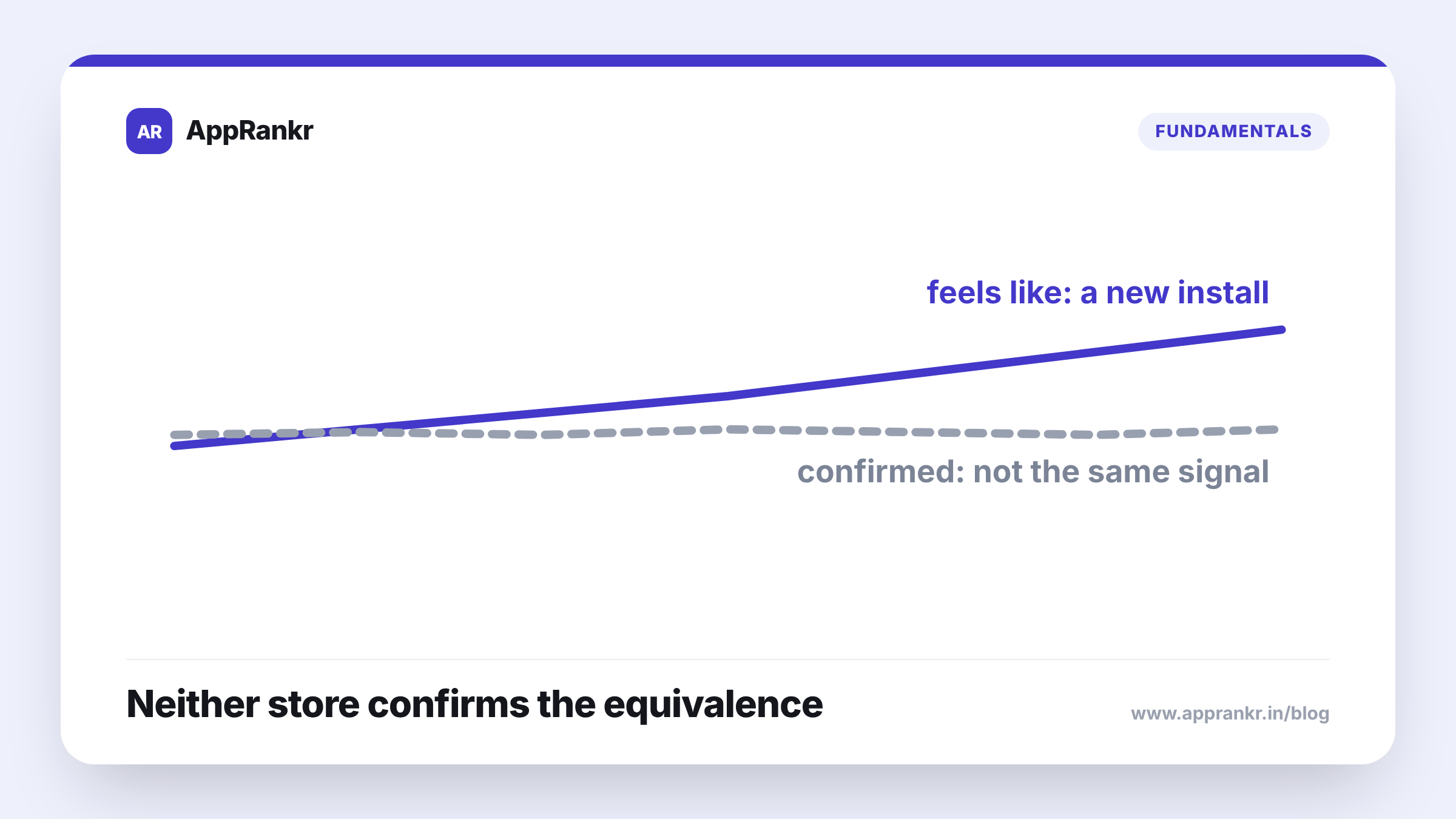
- Treating reinstalls as equivalent to new growth is a weak assumption, not a confirmed fact either way.
- The safer, confirmed-adjacent signal to focus on is real retention and real new-user growth, not reinstall volume.
A user who deletes your app and downloads it again later feels, from where they’re sitting, exactly like a brand-new install. The store almost certainly knows better.
What’s actually different about a reinstall
An account that has downloaded your app before carries real history. The store can see that. Even if the user feels like they’re starting fresh. That’s a different situation from an account downloading for the very first time. Does that difference actually change your visible ranking signal? Neither store spells that out in public. What’s reasonable to assume is simpler. The store isn’t blind to the difference. Even if it stays quiet about what it does with it.
| Detail | What’s actually known |
|---|---|
| Install tied to a returning account | Distinguishable from a first-time install, in principle |
| Official weighting confirmed | Not published by either store |
| Safer assumption | Don’t treat reinstalls as equivalent to new growth |
| Confirmed-adjacent signal | Real retention and real new-user acquisition |
Why this myth is easy to fall for
A reinstall does represent something real. It can mean a lapsed user came back. That’s a genuine, positive sign about your app on its own. The mistake is assuming that signal automatically earns the same ranking benefit a first-time install carries. Nobody has confirmed that. Treating a wave of reinstalls, say from a win-back campaign, as something that should move your rank the same way new users would, is a guess dressed up as a fact.
Real-world scenario: A team ran a win-back email campaign aimed at lapsed users. It drove a real spike in reinstalls over one week. They expected their category rank to climb. They treated the spike like a burst of new installs from a launch. Their rank barely moved. Reading through what’s actually confirmed about install signals afterward, they saw it clearly. They’d assumed an equivalence neither store had ever stated. The campaign was still worth running. Winning back a lapsed user has real value on its own. It just wasn’t the ranking lever they’d assumed.
What to actually track instead
Real retention and real new-user growth are the numbers that come up again and again, whenever either store talks about what actually matters for an app’s health. Neither of those is reinstall volume. If you’re picking where to spend real effort, growing your real new-user base and keeping the users you already have are the safer bets. Not a campaign built around getting lapsed users to redownload, hoping it moves a number nobody has confirmed it moves.
What to actually do about it
- Don’t assume reinstalls carry the same ranking weight as new installs. That equivalence isn’t confirmed by either store, in either direction.
- Still value a reinstall for what it actually is. A real sign a lapsed user came back, worth something on its own terms.
- Put your real effort into retention and genuine new-user growth. Those are the metrics that consistently show up as what actually matters.
- Measure a win-back campaign by its own real goal, not by an assumed rank bump. Judge it on return engagement, not a ranking move it was never confirmed to cause.
AppRankr’s Rank Tracker tracks your real rank movement over time, a direct way to see whether a specific campaign actually moved anything, instead of assuming it did.