Key points:
- A branded keyword includes your app’s name. A non-branded keyword doesn’t, and it shows a user finding you without already knowing you.
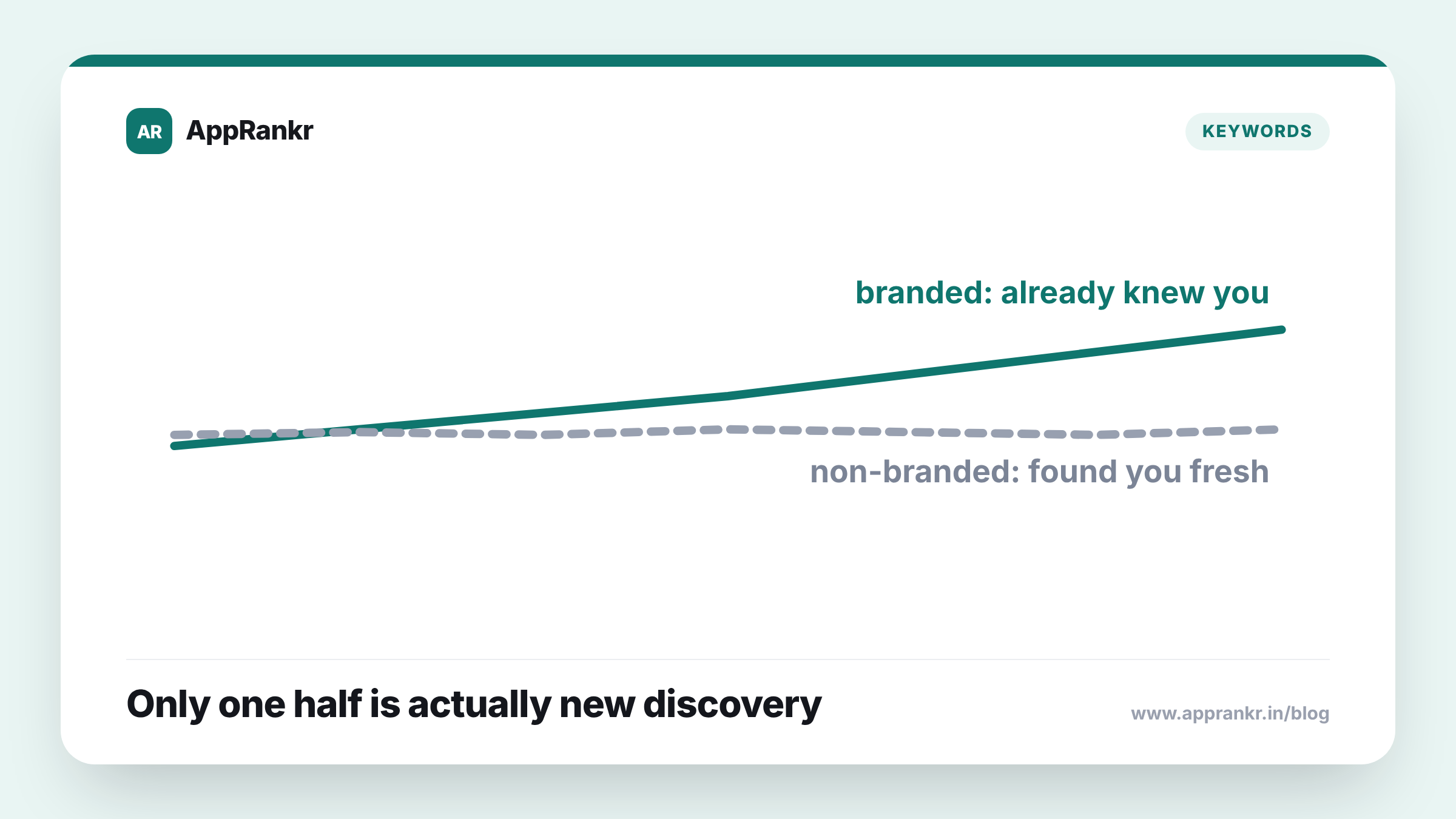
- Blending both into one report hides how much of your visibility is real discovery, versus people who already knew your name.
- A strong overall number can hide weak non-branded performance. You won’t see the gap unless you split the two out.
- The split matters most when you’re checking whether your ASO work is actually growing your reach, not just reaching people who already knew you.
Two searches for your app can look the same in a report and mean two very different things.
What the split actually is
A branded search includes your app’s name, or something close enough that the user clearly already knew what they wanted. A non-branded search skips your name entirely. It’s a plain term, a problem the user is trying to solve, a category they’re browsing. The user who finds you through a non-branded search didn’t know you existed yet. That’s real discovery. The user who searches your brand name already knew exactly what they wanted and went looking for it directly.
| What it shows | |
|---|---|
| Branded keyword | A user who already knew your app’s name |
| Non-branded keyword | A user finding you with no prior knowledge of your name |
Why blending the two misleads you
One combined keyword report can look strong even when your real discovery numbers are weak. If a big chunk of your ranked traffic is just people searching your own brand name, your overall score gets propped up by users who never needed to discover you at all. They already knew you. Your non-branded number, the one that shows whether new users are actually finding you through search, can be quietly stuck underneath that strong-looking total. You won’t see that gap unless you look at the two sides apart.
Real-world scenario: A team watched their keyword score climb and figured their non-branded ASO work was paying off. Splitting the data by branded and non-branded search, they found almost all of the gain had come from branded terms, driven by a marketing push that got more people searching their app’s name directly. Their non-branded number, the one that actually meant new discovery, hadn’t moved at all. The campaign was working. It just wasn’t doing what the team had assumed.
What the split actually tells you
Non-branded performance is the number to watch if your real goal is reaching people beyond those who already know you. Branded performance still matters too. It’s a real sign of brand recognition, and worth defending if a rival ever tries to rank for your own name. But reading a strong branded number as proof your keyword work is paying off is an easy mix-up. The two numbers answer two different questions.
What to actually do about it
- Split your keyword tracking into branded and non-branded groups. One blended number hides which part of your traffic is actually new discovery.
- Judge your ASO work by the non-branded number. That’s the one that shows new users finding you without already knowing your name.
- Still watch your branded number too, for a different reason. It’s worth protecting, since a rival might try to rank for your own brand terms.
- Re-check the split after any marketing push. A campaign can raise branded search without moving your real non-branded discovery at all.
AppRankr’s ASO Inspector breaks down your keyword performance so you can see which part of your visibility is genuine discovery.