Key points:
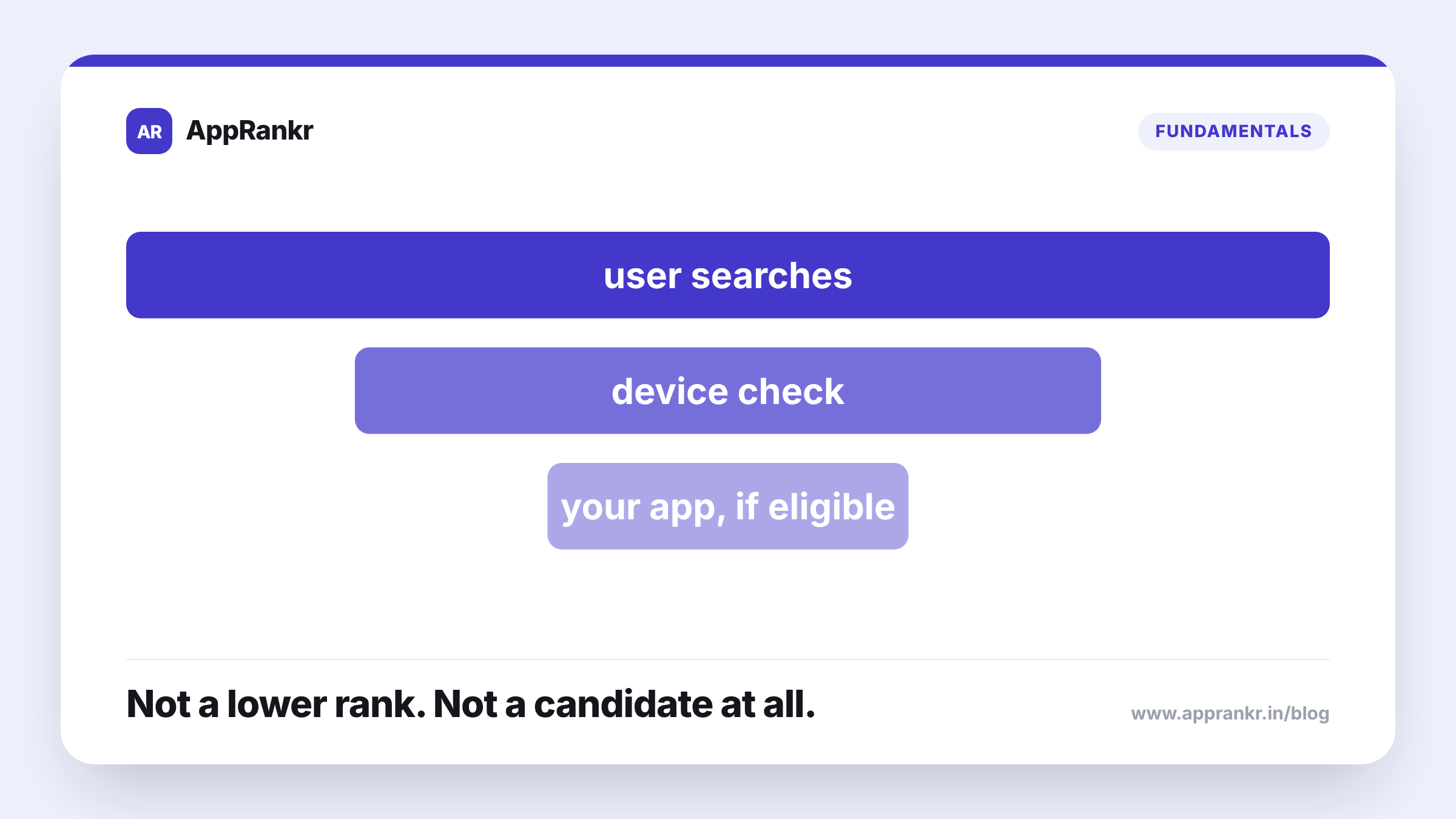
- Supporting fewer devices doesn’t change your rank on a search. It changes who’s even eligible to see that result in the first place.
- A user searching on an unsupported device simply never gets your app as a candidate, no matter how relevant your listing is.
- This is a narrower, more direct effect than a country restriction, which blocks an entire market rather than a slice of hardware within one.
- Excluding devices your app can’t run well on is still the right call. Knowing the visibility tradeoff is the point, not avoiding it.
Dropping support for old or low-end devices usually gets framed as a pure quality call. Fewer crashes, better reviews, a cleaner codebase. It also touches something most teams never think to check: who’s even allowed to see your app at all.
Why this isn’t a ranking signal in the usual sense
A keyword edit or a rating shift moves where you land in results you’re already eligible for. Device support works differently. It decides eligibility itself. If someone searches on a device your app doesn’t support, the store can’t return your app as a candidate. Full stop. You’re not ranking lower for that search. You’re not in it at all.
| What changes | |
|---|---|
| A keyword or title edit | Where you land among eligible results |
| A device-support restriction | Whether you’re an eligible result at all, on that device |
Why this is easy to miss
Most teams track rank by keyword and by country. Those are the two filters every ASO tool shows by default. Device eligibility rarely shows up anywhere. So a decision made for good reasons, like dropping a device generation that kept crashing, can quietly shrink the pool of searches you even compete in. Nobody notices. Nothing in the usual rank chart changes. The searches that would have shown your app just stop happening on your end.
Real-world scenario: A team dropped support for an older generation of low-end devices after watching crash reports pile up from that segment. A reasonable, defensible call. Their tracked keyword ranks looked unchanged in every report they checked. A closer look at impression volume showed a real dip lining up with the change. Not from ranking worse. From a real slice of searches on those older devices no longer being able to return the app as an option at all.
What to actually do about it
- Treat device support as its own decision, separate from keyword strategy. It affects eligibility, not position, so it won’t show up in a normal rank chart.
- Check impression volume, not just rank, after a device-support change. A real drop there can mean fewer eligible searches, not a worse-performing listing.
- Don’t let this talk you out of dropping devices that genuinely hurt quality. The tradeoff is real, but it’s usually still the right call for crash rate and ratings.
- Know this is a different lever than country restriction. One limits an entire market. The other limits a slice of hardware inside a market you’re already in.
AppRankr’s Rank Tracker watches your real impression and rank numbers together, a clearer way to catch a shift like this before it looks like a mystery.