Key points:
- Two listings for one product each build their own separate ranking history. Signals don’t automatically combine across them.
- A keyword, a review base, and an install history split across two listings is weaker evidence for either than the same signals in one place.
- Having both a free and paid version is still often the right call for reaching different kinds of users.
- The two listings aren’t free extra shelf space. They’re two separate competitors for mostly the same search terms.
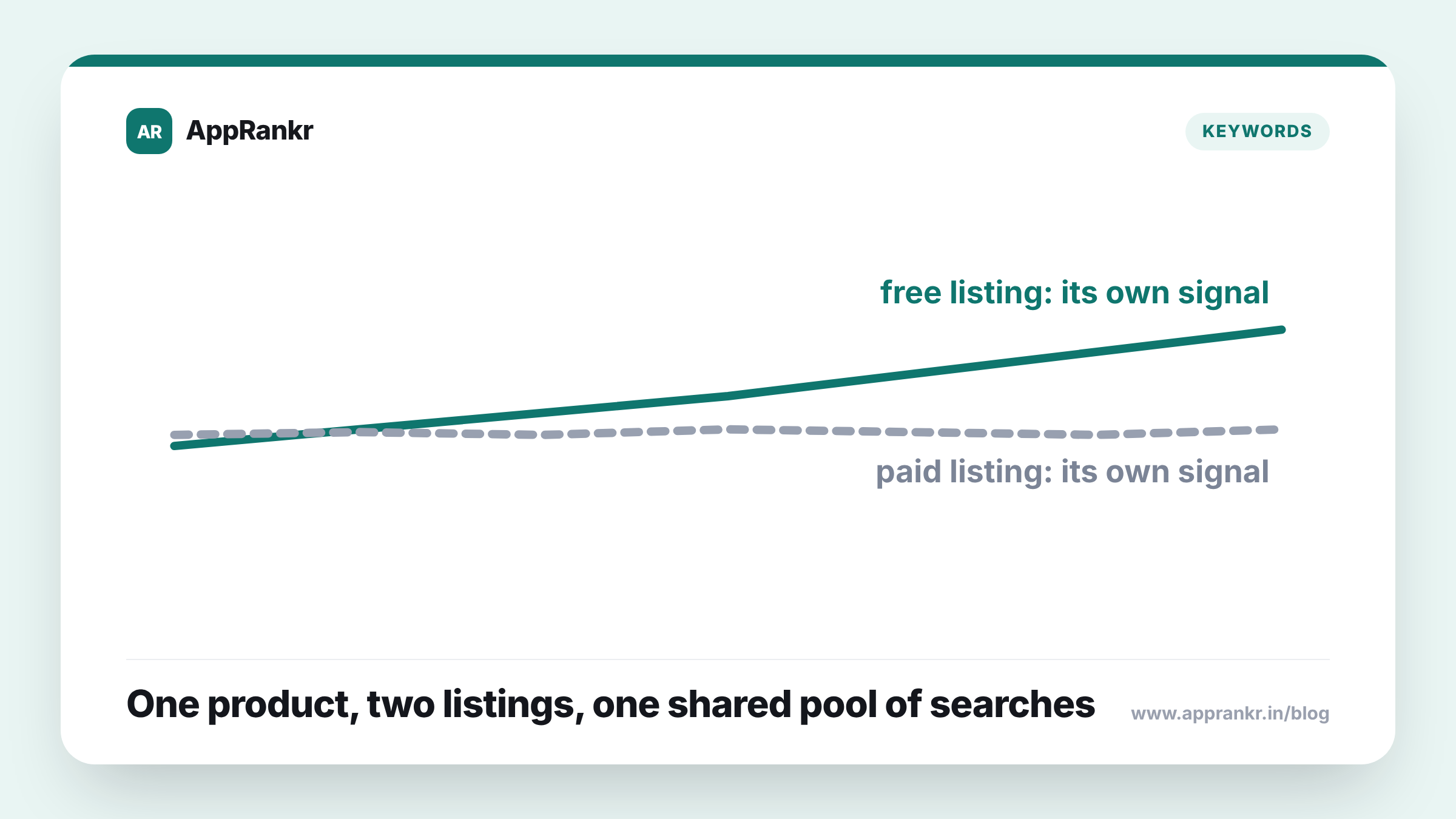
Running a free version and a paid version of the same app feels like getting two shots at the same keyword instead of one. In practice, it’s closer to running two smaller competitors against each other.
Why two listings don’t add up the way you’d expect
Every ranking signal a store tracks, installs, reviews, keyword history, engagement, builds up per listing, not per product. A free version and a paid version of the same app are two separate listings in the store’s eyes, even though you think of them as one thing. Split your user base across both, and neither listing accumulates the full weight of signal your product actually generated. The whole is genuinely more than either half.
| What the store sees | |
|---|---|
| One listing, one version | All signal concentrated in one place |
| Free + paid listings | The same total signal, split across two places |
Why this doesn’t mean drop one of them
A free and paid split often exists for a real reason: some users want to try before buying, others want to pay once and skip ads or limits entirely. That’s a legitimate product decision, not a mistake. The point isn’t that running two versions is wrong. It’s that the two listings genuinely compete with each other for a lot of the same keywords and the same searchers, so they shouldn’t be treated as simply double the visibility.
Real-world scenario: A team ran a free version with ads and a separate paid, ad-free version, assuming the two listings together gave them twice the keyword reach of a single app. Reviewing both listings’ individual rank history showed each one performing roughly like a smaller, newer competitor on their core terms, not like one strong app with double the presence. Consolidating marketing push and review requests toward the free version, which carried more of the actual install base, measurably improved its own rank without the paid version losing meaningful ground.
What to actually do about it
- Track both listings’ rankings separately, not as one combined number. They’re two distinct competitors in the store’s own system, even if you think of them as one app.
- Decide which listing should carry the bulk of your keyword and review push. Splitting effort evenly often under-serves both instead of helping either.
- Don’t assume two listings mean double the visibility. They’re sharing a pool of the same searches, not multiplying it.
- Keep the free/paid split if it genuinely serves two different kinds of users. The tradeoff is real, but it’s often still worth it for reach.
AppRankr’s Rank Tracker can track multiple listings for the same product side by side, a clearer way to see how they’re actually splitting your real keyword visibility.