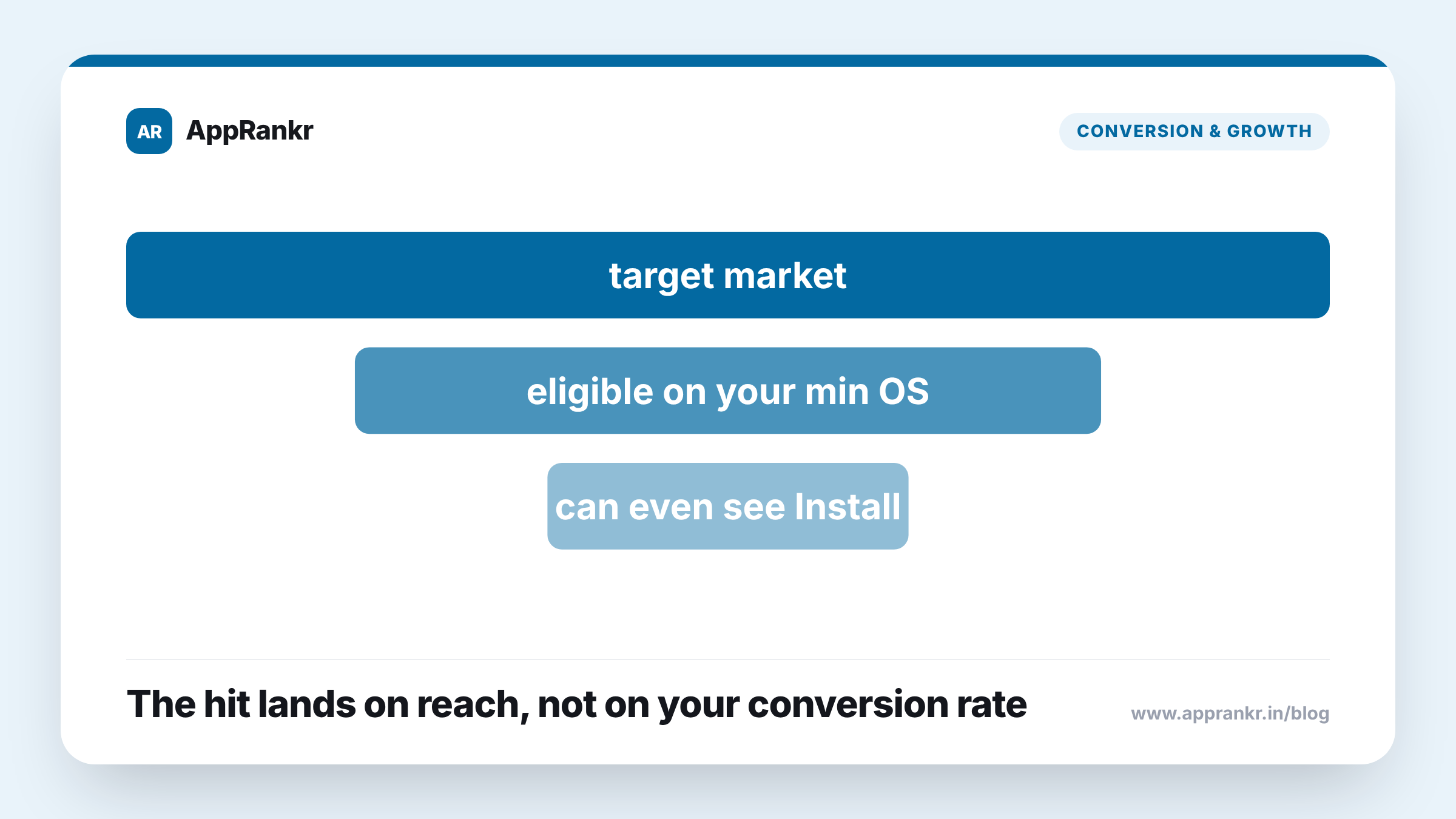
Key points:
- A user on an old OS version usually never sees your install option at all. That traffic doesn’t show up as a failed conversion.
- The real cost is a smaller pool of eligible users, not a lower rate among the users who can actually reach your listing.
- Fewer eligible users can still mean fewer total installs, even with a rate that never changes.
- The right call depends on how much of your market still runs old OS versions. There’s no fixed rule either way.
Raising your minimum OS version feels like it should show up as a conversion problem. It usually shows up somewhere else.
What actually happens
Most stores filter out ineligible users before they ever reach your listing as a real visit. A device running an OS below your stated minimum can’t find or install your app through normal search and browse. That user never enters your conversion math at all. They’re not a visitor who saw your listing and said no. The real effect isn’t a worse rate. It’s a smaller pool of people who could ever convert in the first place.
| What people assume | What actually happens |
|---|---|
| A higher minimum OS hurts conversion rate | Old-OS users usually never register as a visit at all |
| The conversion math takes the hit | Your pool of eligible users takes the hit instead |
| The rate drops | Total installs can drop, even with a rate that stays flat |
Why the real cost is still easy to miss
A steady conversion rate can hide a shrinking pool right underneath it. If your eligible group of users shrinks, your total install count can fall even while every number on your normal dashboard, like conversion rate, looks exactly the same as before. The cost shows up quietly. Fewer installs overall. Not as a red flag on the one number most teams check first.
Real-world scenario: A team raised their minimum OS requirement to use a feature only newer versions support. Their conversion rate barely moved for months afterward. Total installs, though, dropped more than they’d expected for that stretch. When they checked their real target market, a bigger share than they’d guessed was still on an older OS, big enough that their eligible pool had shrunk in a real way. The rate had never budged. The group behind it had.
How to actually weigh the tradeoff
This isn’t a call with one right answer every time. A newer OS requirement can bring real wins. Cleaner code. New platform features. Less time spent testing old versions. The question worth asking first is simple: how big is the old-OS slice of your real target market right now? A small, shrinking slice makes this an easy call. A real chunk of your actual users still on old versions makes it a true cost worth weighing against what you’d gain.
What to actually do about it
- Check your target market’s OS spread before you raise the minimum. The real cost scales directly with how many real users still sit below your new line.
- Don’t judge the move by conversion rate alone. The damage, if any, shows up in total installs, not in the rate among users who already made it to your listing.
- Re-check the tradeoff now and then, not just once. Old-OS use shrinks over time, so a cut that looked costly a year ago may cost far less today.
- Weigh the real feature gain against the users you’d lose. Sometimes the newer capability is worth it. Sometimes the group you’d give up isn’t small enough yet.
AppRankr’s Rank Tracker tracks your real install trend over time, a useful way to check whether a move like this actually changed your numbers.