Key points:
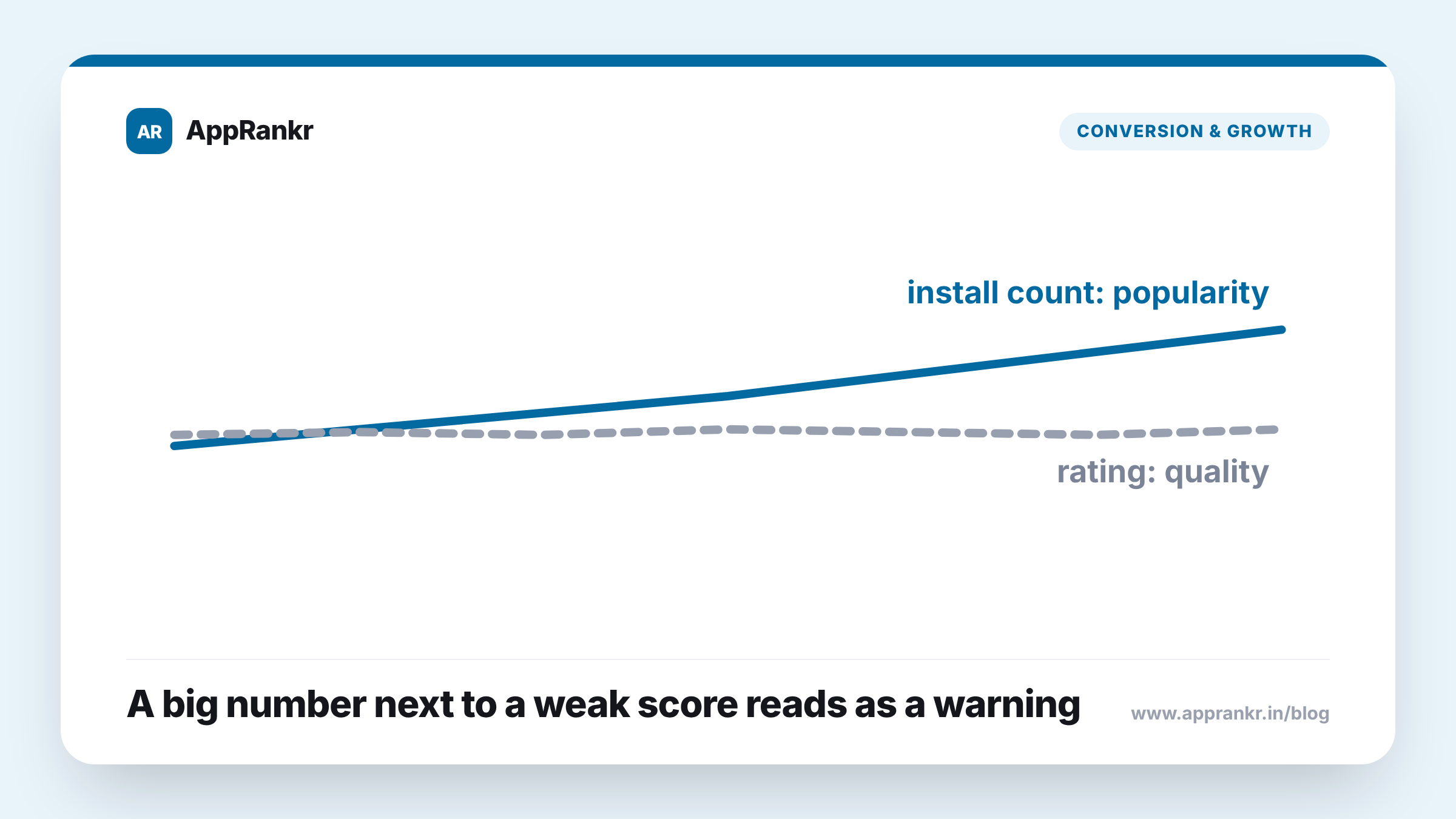
- Install count signals popularity, how many people tried the app. Rating signals quality, how they felt about it after. Different questions.
- A high install count next to a weak rating can read as a warning, not reassurance, since it implies a lot of people tried it and the result stayed middling.
- Install count likely carries different weight by category, mattering more where popularity itself is part of the appeal.
- Read the two signals together. Don’t treat them as stand-ins for the same thing.
A big number and a star score sitting side by side look like they’re both saying “this is good.” They’re not quite answering the same question.
Why these are two separate signals
An install count answers a popularity question. How many people have tried this app. A star rating answers a quality question. How did the people who tried it feel about it after. A listing can show a huge install count next to a mediocre rating. That tells a specific, slightly uncomfortable story. A lot of people tried it, and the result was still middling. Treating a high install count as automatic reassurance skips the fact that it answers a different question than the one about real quality.
| What it answers | |
|---|---|
| Install count | How many people have tried the app |
| Star rating | How those people felt about it after |
Why a high count can backfire without a strong rating
A large install count paired with a weak rating doesn’t read as “lots of people love this.” It reads as “lots of people tried this, and the verdict wasn’t great,” which can land worse than a small count with no rating shown at all. The number meant to work as social proof ends up making the weaker signal next to it louder, not quieter, since a reader naturally reads both together rather than picking just the flattering one.
Real-world scenario: A team was proud of a large, genuinely strong install count and assumed it was doing real work as proof on their listing, helping offset a rating that had dipped during a rough release. Looking at real conversion data from that stretch, the big install count next to the lower rating didn’t seem to be reassuring new visitors. If anything, the pairing seemed to invite more doubt. A lot of people tried it, and this is what they thought. Once the team focused on actually raising the rating itself, instead of leaning on the install count to carry the impression, conversion moved in a way the big number alone had never managed.
Where a visible install count genuinely helps
Install count likely does real, positive work in categories where popularity itself is part of what a user wants. A social app where a user wants to know others are actually there. A utility where being widely used is itself reassuring. In those cases, a high number paired with a solid rating can be a real, compounding signal. The caution is specifically about leaning on a high count to cover for a weak rating, not about install count being useless in general.
What to actually do about it
- Don’t treat a high install count as a stand-in for a strong rating. They answer different questions, and a weak rating next to a big number doesn’t disappear just because the number is large.
- Read both signals together, not apart. A visitor does the same, and the pair tells a fuller story than either number alone.
- Put raising your rating ahead of growing your install count. A strong rating next to a modest count tends to read better than the reverse.
- Check whether your category is one where popularity itself matters to users. That’s where a visible install count is likely doing its most real, positive work.
AppRankr’s ASO Inspector tracks your real rating trend, the signal worth prioritizing before leaning on install count as reassurance.