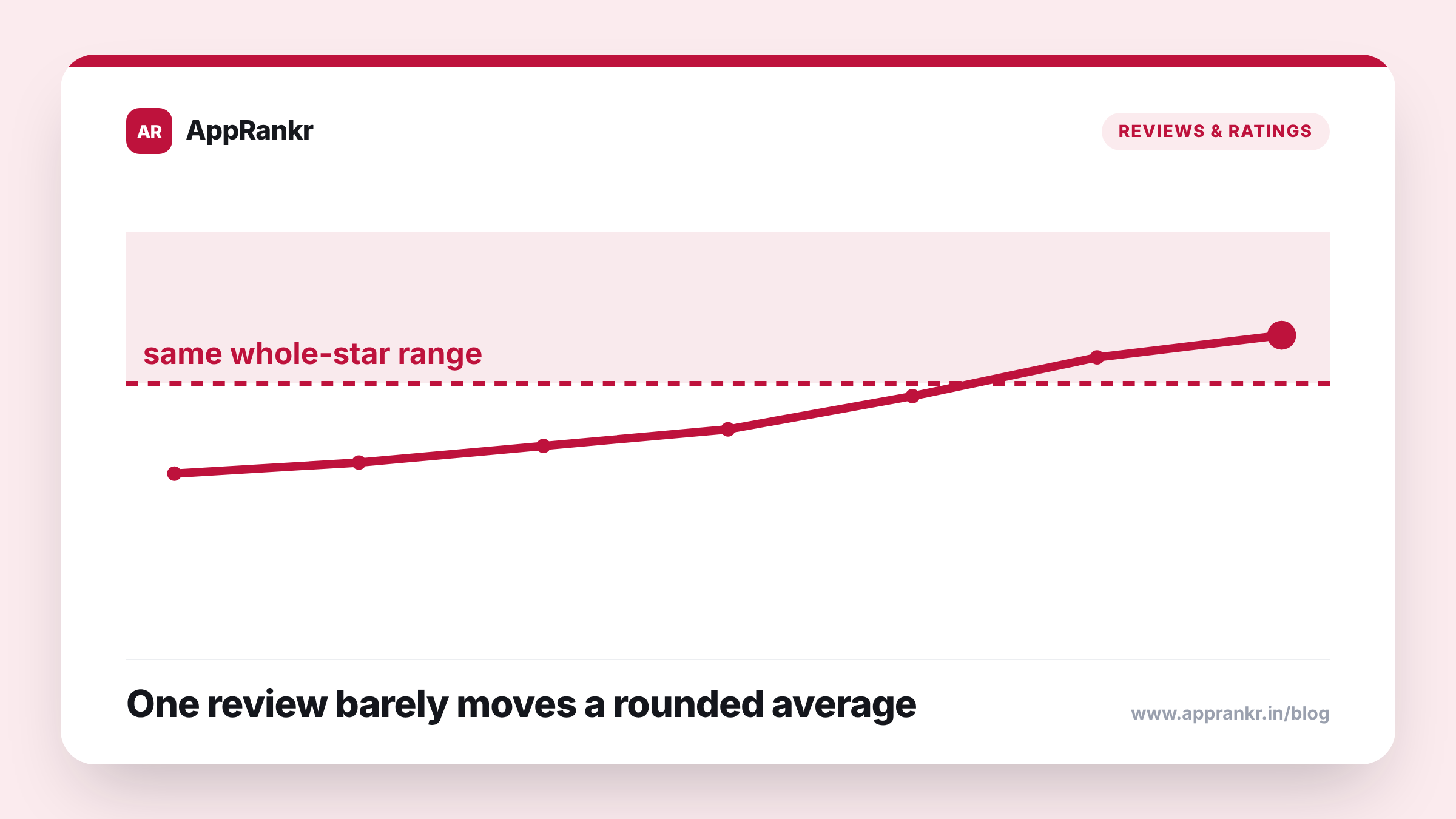
Key points:
- Your star rating is an average across all your ratings, rounded to one decimal place. It isn’t a live score that ticks with each new review.
- One new rating shifts that average by a tiny fraction, far smaller than the gap between two decimal values, once you have any real volume of ratings.
- A visible jump of a full tenth usually means a real batch shift, or a store-side recalculation. Not routine daily activity.
- Crossing a round number, like 3.9 to 4.0, likely matters more to a user scanning search than moving within the 4-star range does.
Watching your rating sit at 4.5 instead of 4.6 can feel like something’s wrong. Most of the time, it’s just the math.
What the decimal actually is
Your star rating is an average, not a live score that jumps with each new rating. It’s built from your full rating history, then rounded to one decimal place for display. Once you have any real number of ratings, one new rating barely moves that average at all. The math makes this clear. Say you have a few thousand ratings averaging 4.52. One new 5-star rating shifts the true average by a number far smaller than 0.1. The decimal you see often doesn’t change at all, since the true average hasn’t crossed into the next rounding bucket yet.
| What’s happening | What it looks like |
|---|---|
| Your true average | A precise number, like 4.547, not a round one |
| What you actually see | That number rounded to one decimal, like 4.5 |
| One new rating’s effect | A tiny shift in the true average, rarely enough to flip the display |
| A full-tenth jump | Usually a real batch shift, or a store-side event |
Why a tenth of a point feels bigger than it is
Staring at your own listing day after day makes small gaps feel huge. A 4.5 next to a rival’s 4.6 looks like a real, closeable gap. Something a better reply habit or a quick push for reviews should fix fast. The math says otherwise, most of the time. Moving a true average from 4.52 up to 4.56, enough to flip the display, can take a real, sustained shift across a big share of your ratings. Not a short, quick campaign. Expecting a fast tenth-of-a-point win asks more of the metric than the math behind it can give.
Real-world scenario: A team ran a two-week push to collect more reviews after noticing they sat at 4.4 while a rival showed 4.5. New reviews came in strongly positive over those two weeks. Their own rating never moved. Checking the real math, they found they already had so many past ratings that two weeks of new ones, even great ones, couldn’t shift the rounded number far enough to flip it. The push wasn’t wasted. The new reviews were still real, good signal. It just wasn’t the fast decimal win the team had hoped for.
What actually does matter
Crossing a round number is a different story from moving within one range. A listing that climbs from 3.9 to 4.0 crosses a line a user scanning search is more likely to notice, since whole numbers read as their own group in a quick glance in a way 4.5 versus 4.6 usually doesn’t. If your rating sits just under a round number, that’s a far better target than chasing a tenth of a point inside a range you’re already safely within.
What to actually do about it
- Stop treating a 0.1 gap within the same whole number as urgent. The math behind the display means it’s usually just noise, not a sign something’s broken.
- Pay more attention to a near-miss on a round number. A rating sitting just under 4.0 or 3.0 is a far better target than one already safely inside a range.
- Judge a review push by your real trend over time, not one decimal. A short campaign often won’t flip the display even when it’s working just fine.
- Keep collecting real reviews steadily. The decimal moves slowly by design. Steady collection over time is what actually shifts a true average, not one quick burst.
AppRankr’s Rank Tracker tracks your real rating and rank trend over time, a clearer read than watching one decimal day to day.