Key points:
- The moment you ask for a review, tied to what the user just felt, tends to matter more than raw prompt count.
- A prompt right after something genuinely went well tends to get a more honest, more positive answer.
- A prompt during frustration, loading, or a half-finished task tends to capture that frustration instead of real satisfaction.
- Tuning timing around real moments of success is a better use of effort than just changing how often you ask.
Two different levers both feel like they should move your review numbers. Only one of them really does.
Why timing tends to beat frequency
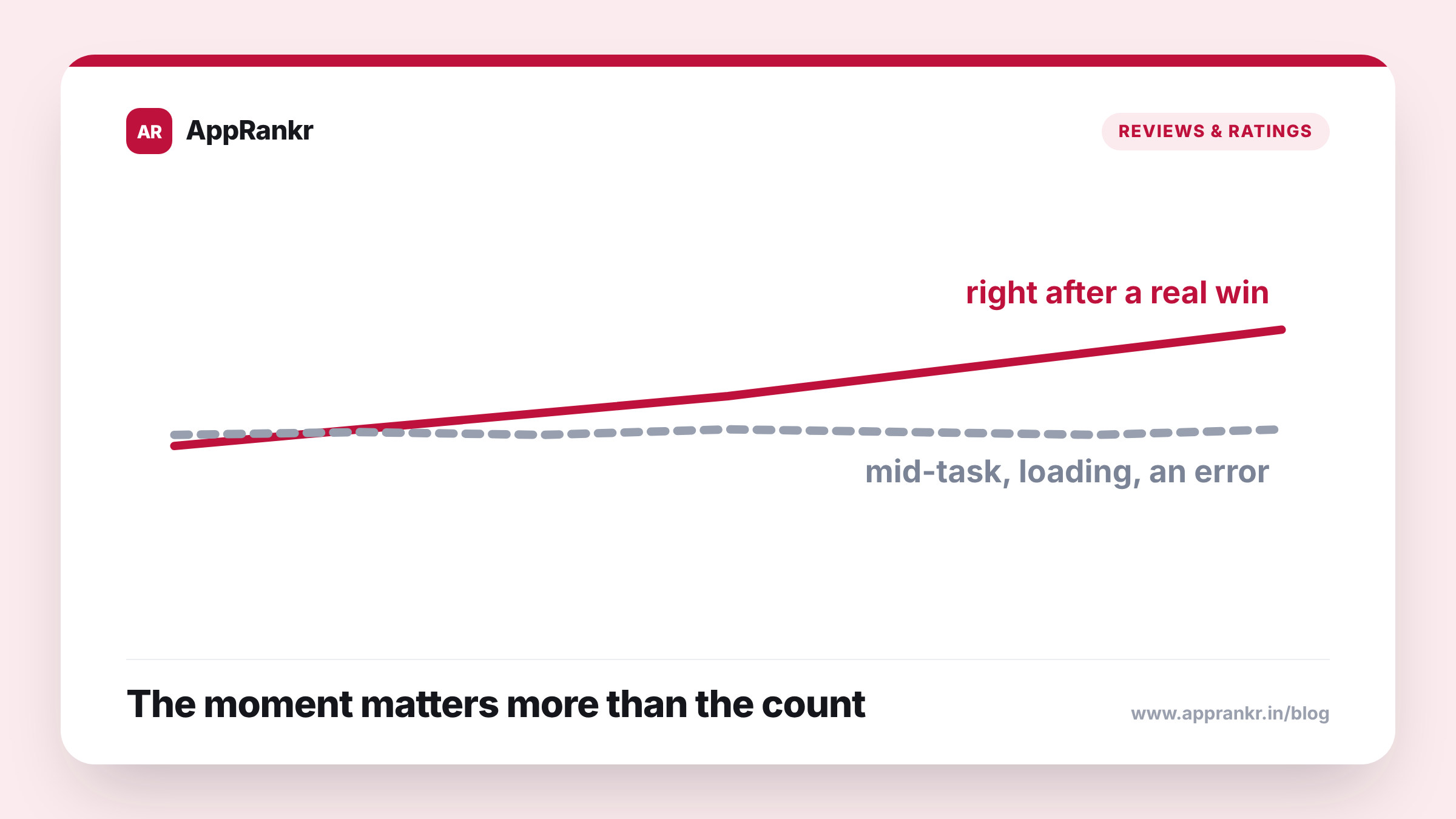
A user’s answer to a review prompt reflects what they’re feeling right then, not their overall, averaged view of your app. Ask right after something genuinely worked, a task done, a goal hit, a problem solved, and you catch a real moment of good feeling. Ask during a loading screen, right after an error, or mid-task before they’re done, and you catch frustration or boredom instead, no matter how good your app actually is overall. More prompts don’t fix a badly timed one. They just repeat the same bad timing more often.
| What it tends to capture | |
|---|---|
| A prompt right after a real win | Real, honest good feeling |
| A prompt during loading or an error | Frustration, no matter how good the app is |
| A prompt mid-task, unfinished | Annoyance at the interruption |
Why frequency gets the attention instead
Frequency is an easy lever to see and tune. It’s a number you can push up or down and watch change on a dashboard. Timing, on the other hand, asks you to actually know your own app’s real moments of user success, which takes more thought than adjusting a count. That’s likely why frequency gets so much focus, even though timing is the piece more likely to change how someone actually answers.
Real-world scenario: A team noticed their review prompt wasn’t landing many good responses and assumed the fix was asking more often, so they raised the prompt count. Response rates ticked up a bit, but so did the share of low ratings, since the prompt kept firing at the same generic point no matter what the user had just done. Moving that same prompt to fire right after a user finished a key task, instead of on a fixed schedule unrelated to what they were doing, led to a clearly higher share of good responses with fewer total prompts shown.
What a genuinely good moment looks like
The thread running through good prompting moments is simple. Something real and good just happened, from the user’s own point of view. A task finished. A result reached. A problem the app itself solved. The user, right then, is more likely to link your app with that good feeling, which is exactly the mood a review prompt benefits from landing in. A bad moment is close to the opposite. Friction, waiting, or an interruption, where whatever the user feels has little to do with how good your app actually is.
What to actually do about it
- Find your app’s real moments of user success first. That’s the groundwork timing actually rests on, and it’s worth more thought than a plain frequency setting.
- Fire your prompt right after one of those moments, not on a fixed schedule. A schedule-based prompt lands wherever it lands, good moment or bad.
- Avoid prompting during loading, errors, or a half-finished task. Those moments catch friction, not real good feeling, no matter how well-tuned your frequency is.
- Don’t assume more prompts fixes a timing problem. A badly timed prompt shown more often just makes more badly timed answers.
AppRankr’s ASO Inspector checks your real rating and review trend over time, a useful way to see whether a timing change actually moved anything.