Key points:
- Adding a rival’s brand name to your own keywords rarely brings in the traffic teams expect from it.
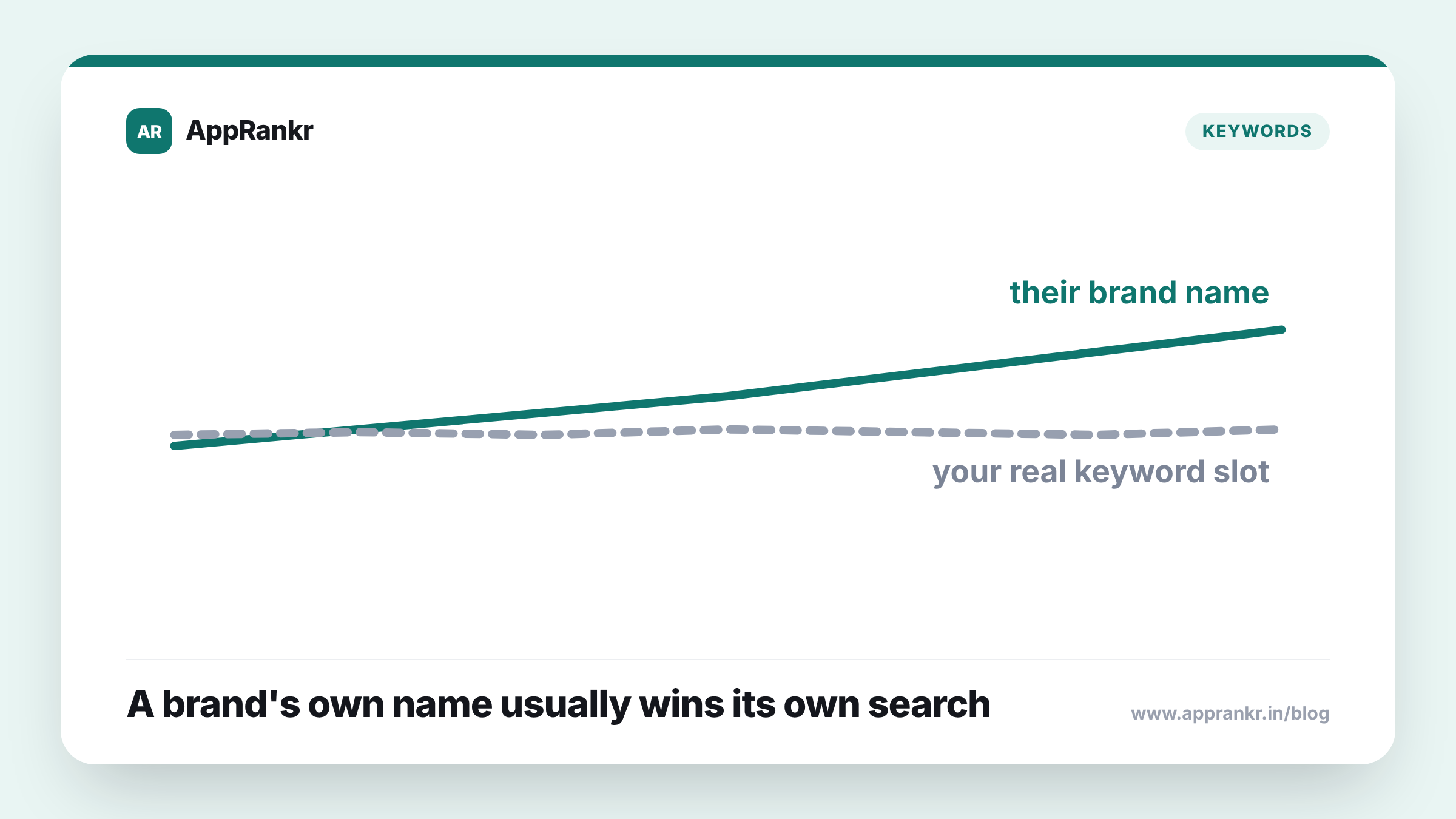
- A brand name search tends to favor that brand’s own listing, which has real advantages a keyword alone can’t match.
- The mechanic works the same both ways, whether you’re targeting a rival’s name or defending your own against it.
- Generic, descriptive terms tied to what your app actually does are usually the better use of the same keyword space.
Borrowing a rival’s name for your own keyword field sounds like a clever shortcut. The real result usually falls well short of the idea.
Why this doesn’t work the way it sounds
A search for a specific brand tends to favor that brand’s own listing. A user searching a brand they already know is looking for that exact app. The store’s matching tends to lean hard toward the real brand for that kind of search. Your own listing, carried only by a keyword with no real tie to that brand, competes from a much weaker spot. You’re not just matching a word. You’re trying to outrank the one app that owns the strongest possible match for its own name.
| Who has the advantage | |
|---|---|
| Brand name search | The actual brand’s own listing, by a wide margin |
| Generic descriptive search | Open to whichever listing is genuinely the best match |
Why teams try it anyway
A competitor’s name usually carries real, big search volume, which makes it tempting to chase. Grabbing even a small slice feels like free traffic for the cost of one keyword slot. The catch is the slice actually open to a non-branded listing is usually far smaller than the headline number suggests. Most of that volume resolves straight to the brand it belongs to.
Real-world scenario: A team added a well-known rival’s name to their keyword field, hoping for a real lift from that brand’s search volume. After a few weeks of tracking, any traffic tied to that specific term was a small fraction of what the rival’s total volume implied, and almost none of it converted. That keyword slot had been spent chasing a result that strongly favored someone else’s app. Swapping it for a plain, descriptive term tied to their own app’s real function brought in noticeably more relevant traffic from that same single slot.
What tends to work better in that same spot
A plain term describing what your app actually does, the kind of search a user runs with no specific brand in mind, is usually open to whichever listing is genuinely the best match. That’s a fairer fight, and often a better use of the same limited keyword space than chasing a brand search you’re unlikely to win anyway.
What to actually do about it
- Don’t expect a rival’s brand name in your keywords to bring real volume. Brand searches tend to go to the actual brand, not a listing merely tagged with its name.
- Spend that keyword space on genuine, descriptive terms instead. Those compete on fairer ground and tend to convert better too.
- Remember the same shield protects you. A rival targeting your brand name faces the same uphill climb against your own listing’s edge.
- Judge any keyword by real impressions and conversions, not assumed volume. A brand’s headline search count rarely reflects what’s actually open to anyone but that brand.
AppRankr’s ASO Inspector tracks which of your keywords are actually earning real impressions, a clearer read than assuming a rival’s name will deliver.