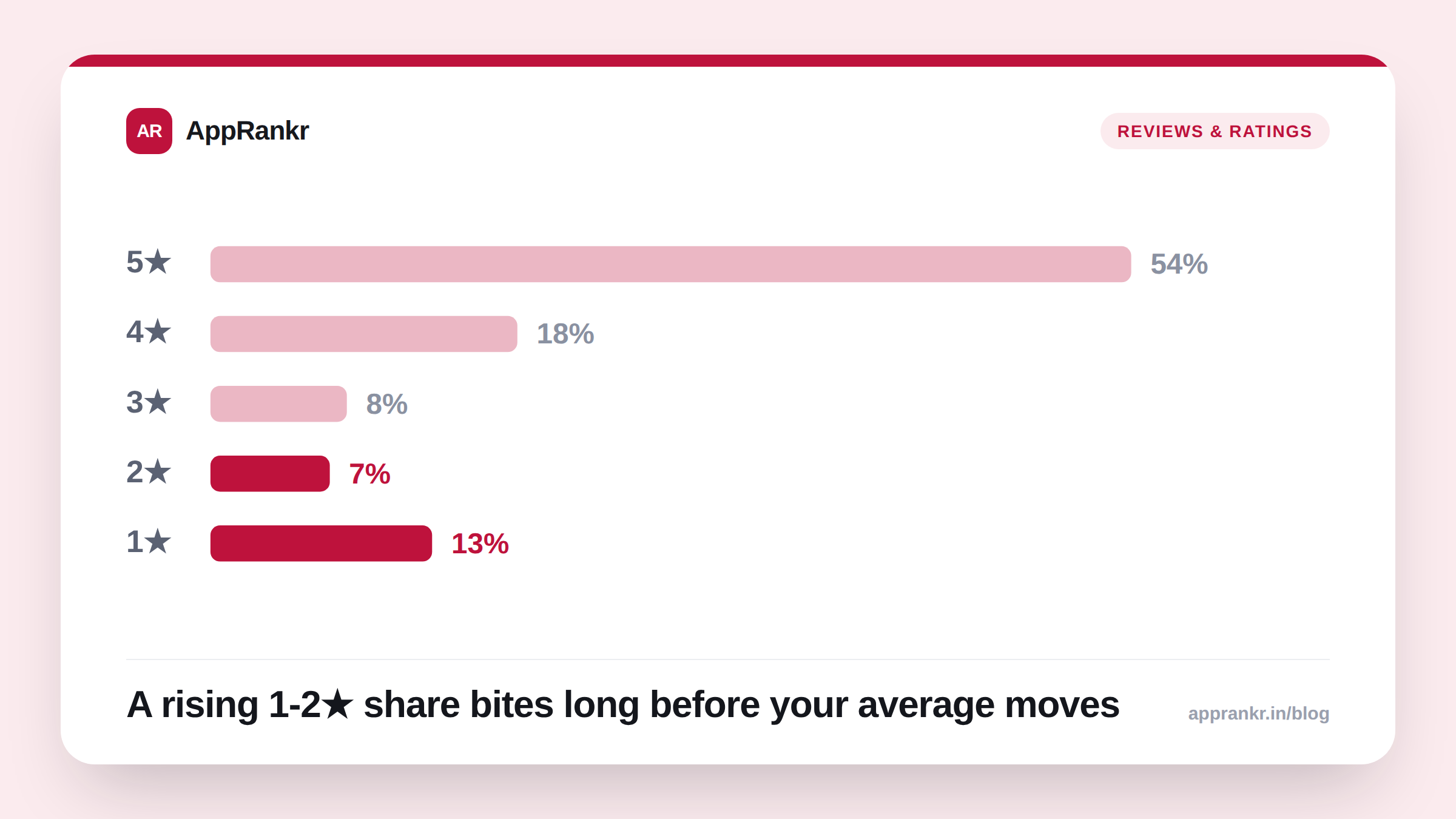
Most teams treat their app rating as a conversion metric: a lower rating means fewer people who see your listing decide to install. That’s true, but it’s only half the story, and treating it as the whole story means you under-react to a rating slide that’s costing you more than you think.
The part people miss: rating is also a ranking signal
Both Google Play and the App Store have stated, in various forms, that quality signals (including rating and rating trend) feed into search ranking, not just how your listing converts once found. This makes sense from the platforms’ own incentives: they want search results that lead to happy outcomes, not just installs, because an install that gets immediately uninstalled and negatively reviewed is a bad outcome for the platform too, not just for you.
The practical consequence: a keyword you used to rank #8 for can quietly slip to #25 over a few weeks of accumulating negative reviews, with zero changes to your listing text, screenshots, or keywords. If you’re only watching your rating number and not your rank, you won’t connect the two until the traffic drop is already significant.
Real-world scenario: A meditation app’s rating held steady at 4.5★ (all-time average) while its last-30-day 1-2★ share quietly rose from 6% to 21% after a subscription-pricing change upset existing users. The all-time number never moved enough to trigger concern, but its rank for its top three keywords dropped an average of 14 positions over that same month, recovering only after the pricing complaints were addressed in a follow-up release.
Why the recent share matters more than the all-time average
An app with 50,000 lifetime ratings and a 4.6★ average can still be actively declining if the last 200 ratings are trending toward 1-2★. The all-time average is slow to move and can mask an active, ongoing problem for months.
This is exactly why rating breakdowns worth paying attention to are windowed, looking at the last 30-90 days of ratings specifically, not the lifetime number. A dated, recent-window view answers “is this getting better or worse right now,” which is the question that actually predicts your near-term rank, not “what has this app’s rating been, ever.”
One practical wrinkle: neither Google Play nor the App Store publicly exposes a clean, dated, day-by-day breakdown of star-only ratings (the silent taps with no written review). The written-review feed is dated, so a rolling window built from written reviews is the closest public proxy available, genuinely representative of the trend, even though it undercounts the silent star-only ratings alongside it.
What actually drives the 1-2★ spike, and how to fix the cause, not the symptom
Chasing the rating number directly (begging for reviews, or worse, incentivizing them (which most platforms explicitly prohibit and will penalize)) treats the symptom. The three most common root causes, in order of how often they show up in real review text:
1. A recent update broke something. This is the single most common driver of a sudden 1-2★ spike, and the easiest to fix once identified. Read the actual review text from the spike window, not just the star counts. If five reviews in three days all mention “crashes on open,” you have your answer and your fix.
2. Support requests going unanswered. A surprising share of 1★ reviews aren’t really about the app being bad. They’re a customer support ticket filed in the only place the user could find, because they couldn’t reach you any other way. Responding to reviews (both platforms let you reply publicly) and, more importantly, actually resolving the underlying issue, measurably recovers rating over the following weeks.
3. Mismatched expectations from your own listing. If your screenshots or description oversell a feature, users arrive expecting something the app doesn’t deliver, and that gap becomes a 2★ review about a feature that “doesn’t work” when really it just doesn’t exist the way the listing implied. This is a rare case where fixing your ASO copy is literally the fix for your rating problem, not the other way around.
| Root cause | Signal to look for | Fix |
|---|---|---|
| Recent update broke something | A cluster of reviews mentioning the same crash/bug within days of each other | Ship a hotfix, respond publicly confirming it’s known |
| Support requests going unanswered | 1★ reviews that read like support tickets, not complaints about the app itself | Reply to reviews; resolve the underlying issue, not just the review |
| Mismatched listing expectations | Reviews calling a real feature “missing” or “doesn’t work” | Fix the screenshot/description claim, not the product |
The monitoring habit that catches this early
Because the rank effect can lag the rating decline by days to weeks, the useful habit is checking your rating trend on a cadence independent of whether you happen to notice a rank drop first. A 1-2★ share that’s climbed from 8% to 18% over three weeks is worth investigating today, even if your rank hasn’t visibly moved yet. Because if the mechanism above is real, it’s likely to move soon.
Practically: watch the trend, not the snapshot. A single bad day of reviews (a bug that shipped and got hotfixed within 24 hours) is noise. A sustained multi-week climb in negative share is signal, and it’s the kind of signal that’s genuinely actionable, find the specific complaint driving it, fix that, and both your rating and your ranking tend to recover together, because they were never really two separate problems.