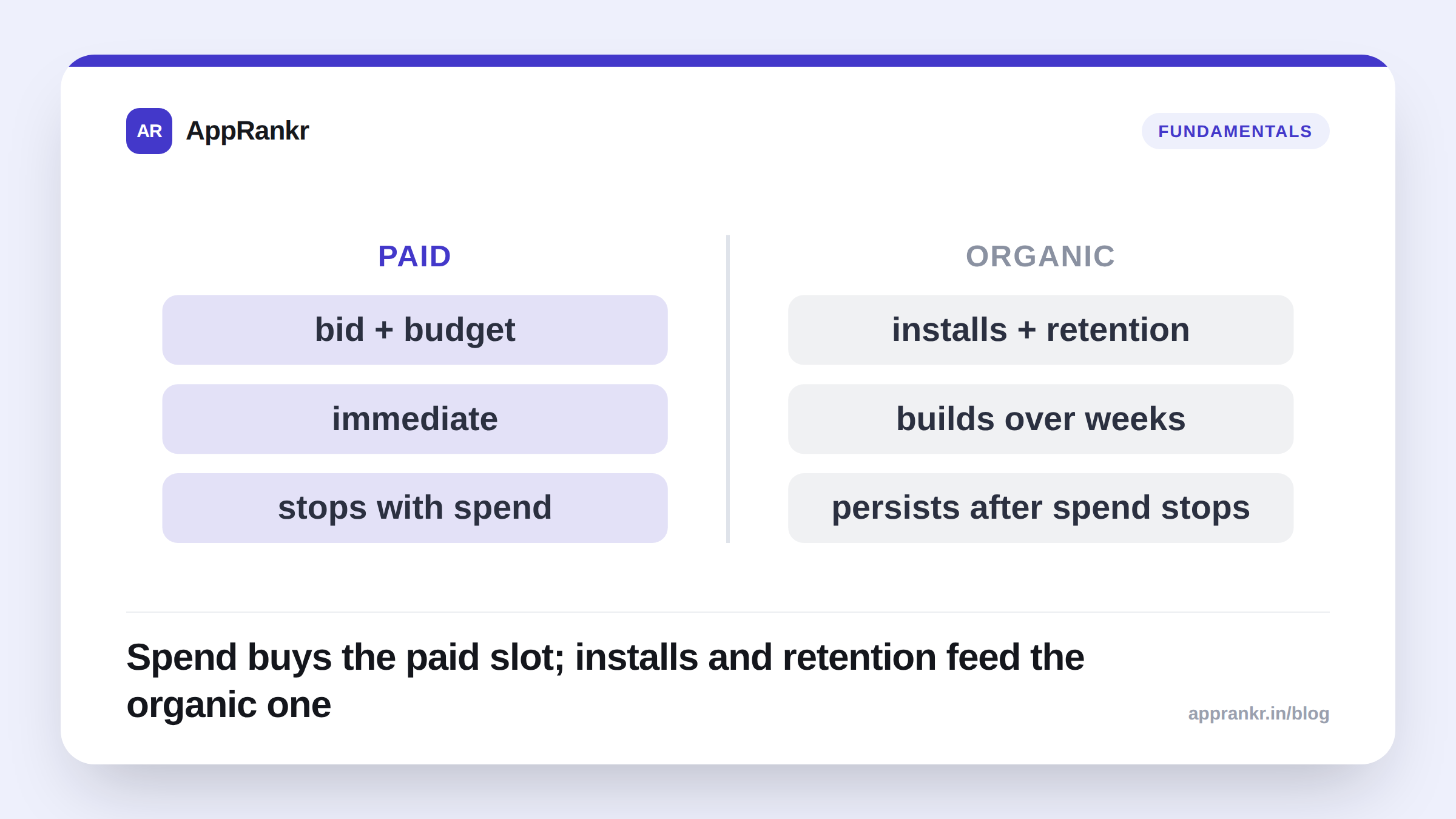
“Does running ads help my organic ranking” is one of the most persistent misconceptions in ASO, mostly because the two numbers sometimes move together, and correlation reads as causation if you’re not looking closely. The direct mechanism doesn’t exist. The indirect one does, and it’s worth understanding the difference.
The direct answer: no shared mechanism
Apple has stated Search Ads and organic App Store Search results are generated by separate systems. Google says the same about Google Ads for App campaigns versus Play Store organic search. Neither company treats ad spend as an organic ranking input; a term you’re bidding on doesn’t get a boost in the un-paid results because you’re paying for the paid slot above or beside it.
| Paid (Search Ads / Google Ads) | Organic | |
|---|---|---|
| What determines placement | Bid, ad relevance, budget | Keyword relevance, install/engagement signal, quality metrics |
| Can you buy your way in | Yes, directly | No, not directly |
| Timeline | Immediate, stops when spend stops | Builds over weeks/months, persists |
The indirect connection that actually exists
Where the confusion comes from: a paid campaign drives real installs, and install velocity plus the retention and engagement behavior those installs produce afterward does feed the organic ranking systems on both stores. So a campaign can produce organic movement, just not through the mechanism most people assume. The chain is paid spend → installs → engagement/retention data → organic signal, not paid spend → organic rank directly. Break any link in that chain (installs that don’t retain, a campaign that drives the wrong audience) and the organic effect doesn’t show up, even with real spend behind it.
This is also why a poorly targeted campaign can actively hurt: installs from users who churn immediately drag down the same retention signal that a well-targeted campaign would have helped, for the same ad spend.
Real-world scenario: A subscription app started an Apple Search Ads campaign on a keyword it wasn’t yet ranking organically for. Within three weeks, organic rank for that exact term moved from unranked into the top 40, and the team initially credited the ad spend directly. Pausing the campaign for a control week showed organic rank held steady rather than reverting, and cohort retention data for the ad-driven installs was strong, in line with the app’s typical retention. The organic movement had come from real engaged installs feeding the ranking system, not from the ad placement itself, confirmed by the fact that pausing ads didn’t undo it.
How to actually use both together
- Use paid to validate a keyword before investing months in organic ASO for it. If a term converts well in a paid campaign, it’s a stronger signal to prioritize for organic effort than a volume estimate alone.
- Watch retention on ad-driven cohorts specifically, not just install count. Retention is one of the confirmed inputs to organic ranking, a campaign that drives volume without retention won’t produce the organic lift you might expect.
- Don’t read a paused campaign’s rank drop as proof paid was “holding up” your organic rank. If organic rank falls after pausing ads, check whether overall install/engagement volume fell too, that’s a volume effect, not evidence the ad slot itself was propping up the organic result.
- Track organic and paid rank as separate lines, the same way you’d track any two related-but-distinct metrics, so a real organic trend isn’t lost inside campaign-driven noise.
Paid and organic answer different questions on different timelines. Spend can indirectly feed organic signal through real engaged installs, but it was never a direct lever, and treating it as one leads to either overspending expecting a rank shortcut, or wrongly crediting a campaign for movement that installs and retention actually earned.