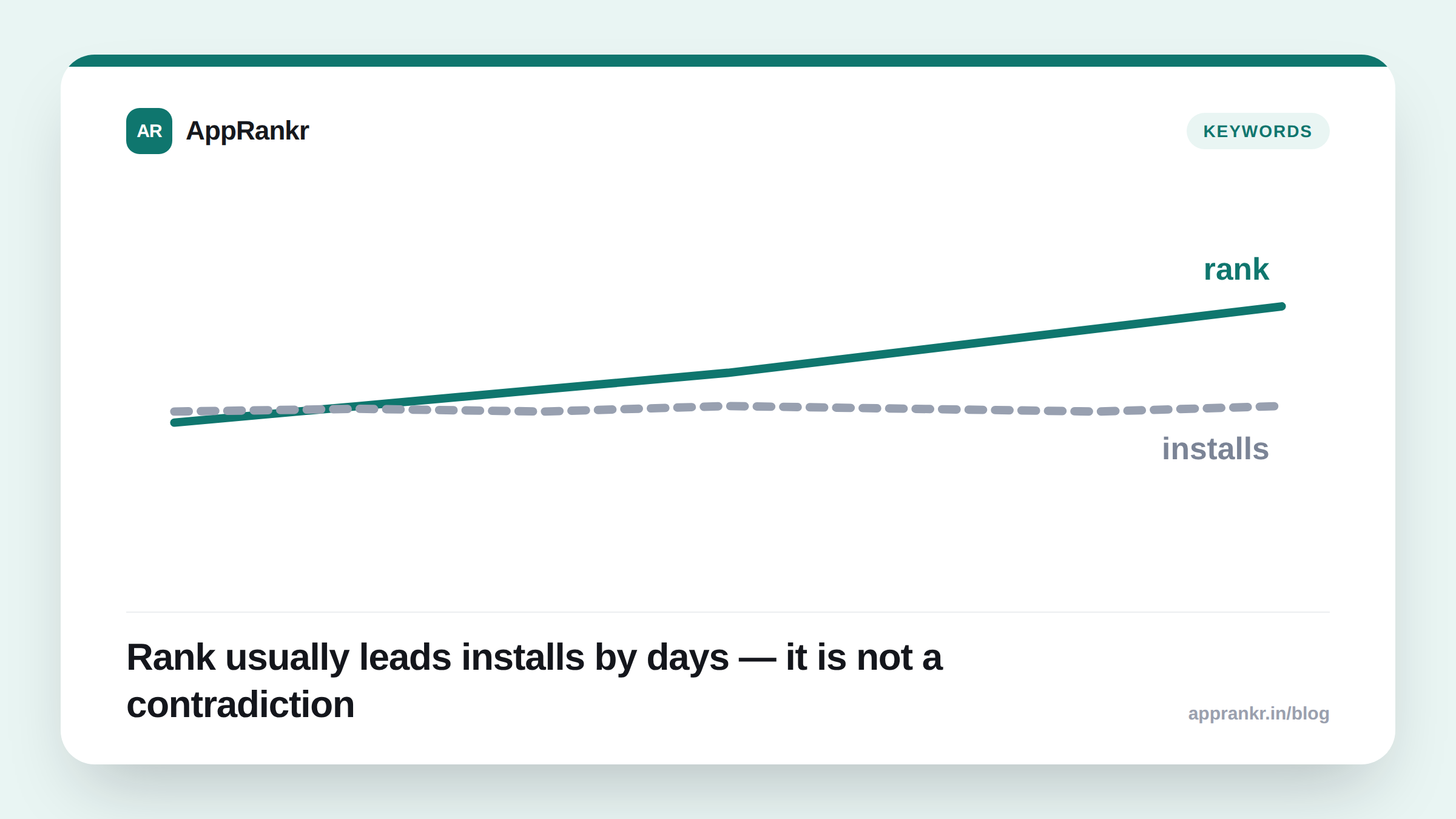
A keyword’s position moves and your download chart doesn’t. That’s not a contradiction, and it doesn’t mean the rank drop is meaningless, it means rank and downloads are related through a few extra steps that are worth understanding before you decide whether to worry.
Why the two numbers can disagree
| Reason | What it means for you |
|---|---|
| The keyword has low search volume | A drop on a term few people search barely touches your install total either way |
| The drop stayed within the same visible cluster | Position 3 to 6 is still “near the top” to most users scanning results; the click-through difference can be small |
| Other keywords picked up the slack | Your total installs are a sum across every keyword you rank for, a loss on one can be masked by a gain on another |
| Seasonality moved in the same window | Underlying demand shifted at the same time as your rank, netting out to a flat download chart that hides two real, opposite changes |
| The drop is too recent | Downloads often lag a rank change by days, not hours, especially if your install cycle involves research or comparison before the download |
Weight the drop by the keyword’s volume before reacting
A position drop from #3 to #8 on your single highest-volume keyword is a real problem worth acting on immediately. The identical drop, in raw position terms, on a keyword almost nobody searches is close to irrelevant. Search volume data attached to your keyword list is what turns “my rank dropped” from an alarming headline into a number you can actually prioritize against everything else competing for your attention that week.
Check whether the drop crossed a visible threshold
Users don’t scan results as a smooth continuum, they scan the first screen, maybe scroll once, and stop. A drop from position 2 to position 5 usually stays within that first-look zone, users scanning the top results will likely still see you. A drop from position 9 to position 11 can push you off the first screen of results entirely, a much bigger real-world change for what looks like a similar-sized numeric move. Read your visibility score alongside raw position for this reason. It’s built to weight positions non-linearly, closer to how discoverability actually works, rather than treating every rank point as equally worth the same amount of traffic.
Rank tends to lead downloads, not move with them
If a keyword rank has genuinely slipped, and it’s a keyword with real volume, treat it as a leading indicator rather than waiting for the download chart to confirm the problem. A position that’s degrading but hasn’t cost you installs yet is closer to costing you installs than a position that’s already stable at a worse spot, the download impact is often a matter of days, not a guarantee it won’t happen.
Real-world scenario: A fintech app tracked “mutual fund investment” and watched it slip from #6 to #11 over ten days, while their weekly install total stayed essentially flat. The temptation was to file it as a non-issue. Volume data showed the keyword was their second-highest by search interest, and checking the visible-threshold question showed #11 had pushed them past the first screen on most devices. Downloads specifically attributable to that keyword (tracked via a UTM-tagged store listing experiment link) had in fact dropped, it just wasn’t visible in the aggregate number because two other keywords had a good week at the same time. Fixing the listing for that term recovered the position within two weeks.
What to actually do, in order
- Weight the drop by the keyword’s actual search volume, not raw position change, before deciding how urgent it is.
- Check whether the new position crossed a visible threshold, off the first screen, out of the top handful, rather than just moving down.
- Look at total downloads by keyword-level channel if you can, not just the aggregate, since a keyword-specific loss can hide inside an otherwise flat overall number.
- Treat a real, volume-weighted drop as worth fixing even with flat downloads today, rank tends to lead, not lag.
Rank and downloads telling different short-term stories isn’t a bug in your tracking, it’s how the relationship actually works. The fix is reading the drop with volume and visibility context, not waiting for the download chart to agree with you before acting.