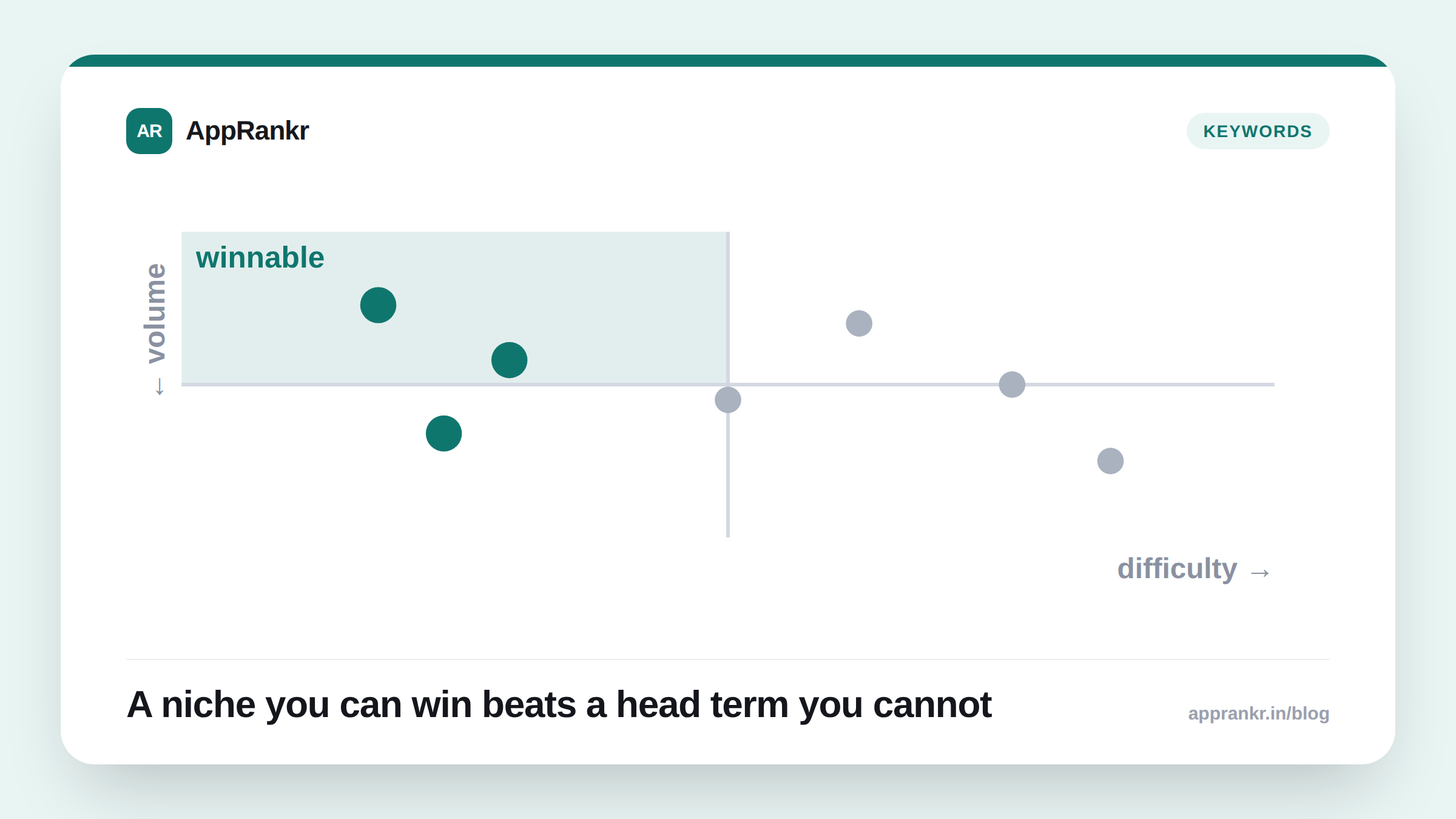
The most common keyword research mistake isn’t picking bad keywords. It’s picking only the obvious ones. Every app in your category is already targeting the same handful of high-volume, high-competition terms. Ranking for “photo editor” when you’re a two-person team competing against apps with millions of installs isn’t a strategy, it’s a lottery ticket.
Good keyword research is a portfolio decision: a mix of terms you can realistically win now, terms worth chasing over months, and one or two ambitious terms you track but don’t expect to rank for soon.
Volume: what it actually tells you
Search volume is an estimate of how many people search a term in a given period. Higher volume means more potential traffic if you rank well for it, but volume by itself tells you nothing about whether ranking is achievable, or whether the people searching that term actually want what your app offers.
A few things volume numbers get wrong if you take them at face value:
Volume is usually a proxy, not a direct count. Neither Apple nor Google publishes exact search volume per term. Every number you see from any ASO tool (including the volume-scoring in this one) is modeled from indirect signals (autosuggest behavior, category browse data, or panel-based estimates). Treat volume numbers as directionally useful for comparing keywords against each other, not as a precise, absolute count of monthly searches.
High volume often means high ambiguity. “Tracker” is high volume because it’s used for fitness trackers, budget trackers, package trackers, and habit trackers all at once. A more specific term like “package delivery tracker” has lower raw volume but a much higher percentage of searchers who actually want your exact category of app.
Volume shifts with season and news. A tax-filing app’s keyword volume for “tax calculator” is wildly seasonal. A fitness app’s volume for “new year fitness” spikes in January and is dead by March. Pull volume data close to when you’re planning to act on it, not from a stale spreadsheet.
Difficulty: the part most tools guess at
“Keyword difficulty” scores, wherever you see them, are estimating how hard it would be for an average app to break into the top results for that term, usually based on how strong (installs, rating, brand recognition) the apps currently occupying the top spots are.
The honest limitation: difficulty scores can’t know your specific app’s strengths. An app with a genuinely excellent 4.8★ rating and strong retention might realistically contest a keyword a generic difficulty score would call “hard.” The reverse is also true. A keyword scored “easy” might have one entrenched, extremely strong incumbent that a raw average masks.
This is why your own historical rank data is a better difficulty signal than any generic score: if you’ve been stuck at position 40 for a keyword for two months despite active optimization, that’s a much more honest difficulty read for your app specifically than a one-time estimate.
The three-bucket approach
Rather than treating keyword selection as one flat list, split candidates into three buckets before you commit tracking and optimization effort:
Bucket 1, Winnable now. Lower-to-medium volume, low competition, close match to what your app already does well. These are your fastest wins and the ones to put in your title/subtitle immediately.
Bucket 2, Worth the campaign. Medium-to-high volume, moderate competition, a term you could realistically reach top-10 for within 2-3 months of sustained optimization (screenshots, description updates, encouraging reviews that mention the term naturally). Track these closely and treat any movement as a signal your broader ASO work is or isn’t working.
Bucket 3, Aspirational / brand-adjacent. The big, obvious, high-competition terms. Keep 1-2 of these tracked for competitive awareness (are you gaining or losing ground against the market leaders?) but don’t build your whole strategy around moving them. They’re a marathon, not something a title tweak fixes.
| Bucket | Volume | Competition | What to do with it |
|---|---|---|---|
| 1, Winnable now | Low-medium | Low | Put in title/subtitle immediately |
| 2, Worth the campaign | Medium-high | Moderate | Optimize toward it over 2-3 months, track weekly |
| 3, Aspirational | High | High | Track for awareness only, don’t build strategy around it |
Real-world scenario: A package-delivery app bucketed “parcel tracker” (Bucket 1, low competition, close match), “delivery tracking app” (Bucket 2 (realistic within a quarter), and “tracker” (Bucket 3) huge volume, hopelessly ambiguous and contested). Six weeks in, Bucket 1 had moved from #22 to #4; Bucket 2 had moved from unranked to #31; Bucket 3 hadn’t budged. Exactly the pattern the bucket assignment predicted, which is the point of splitting them up front rather than judging one flat list by a single average.
A practical way to build your list
- Start from your actual feature set, not aspirational positioning. What does the app genuinely do, in the words a real user would type?
- Pull autosuggest / “customers also searched” style completions for your core terms. These surface real query variants you wouldn’t brainstorm yourself.
- Check who currently ranks for each candidate term and honestly assess whether your app is competitive with them today.
- Assign each term to a bucket, and track all three buckets over time: not just the ones you’re actively optimizing. Watching Bucket 3 terms drift, even without effort, tells you whether the whole category is moving in a direction you need to react to.
The goal isn’t a longer keyword list. It’s a list where you know why each term is on it, and what you’d expect to see happen if your ASO work is actually paying off.