Key points:
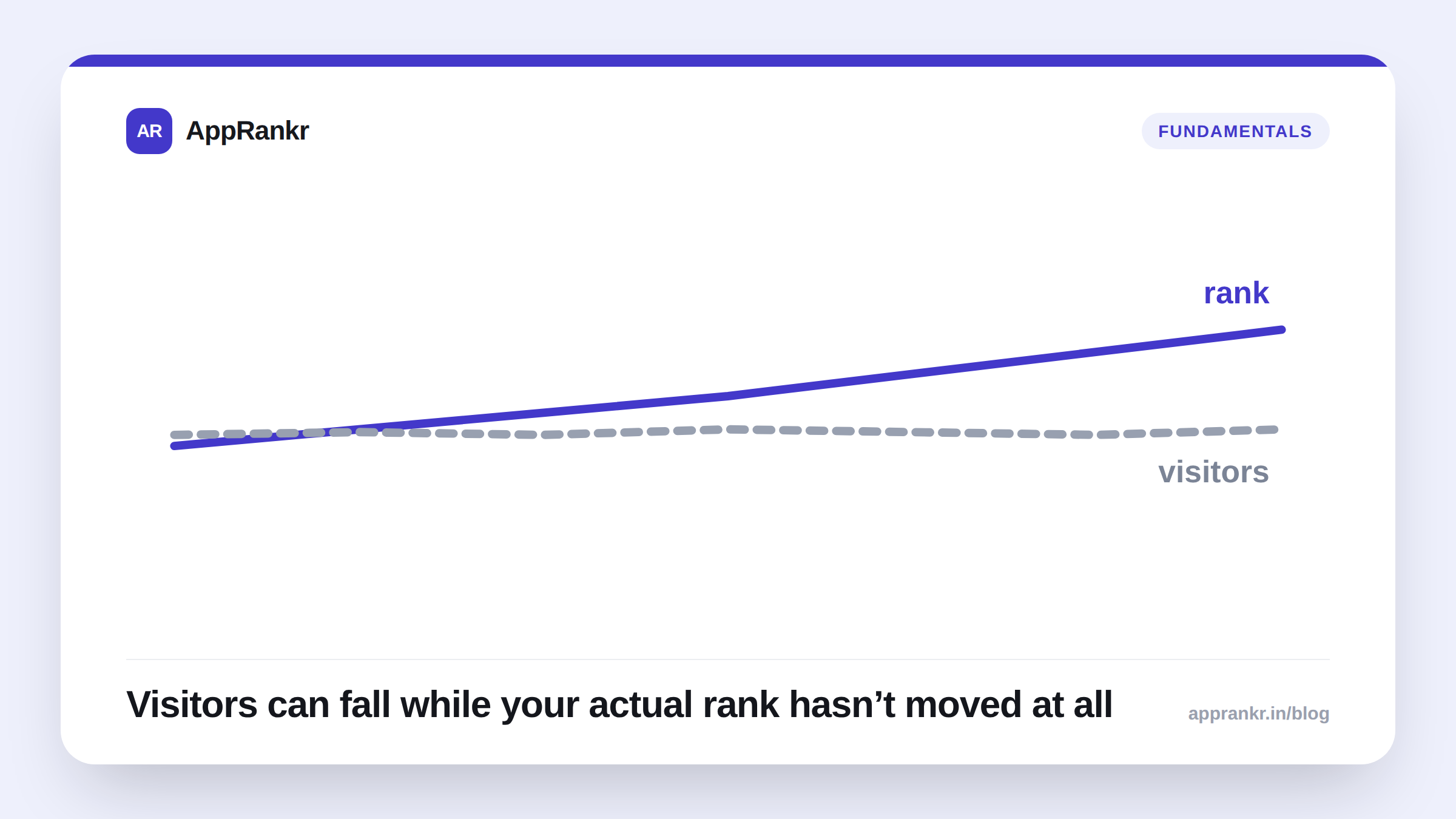
- A visitor drop and a rank drop are different metrics. People mix them up often. You can lose visitors while your keyword positions haven’t moved at all.
- Check your tracked keyword rank first. If positions are stable, the cause is elsewhere: demand, a paused campaign, or a store-side issue.
- “Sudden huge drop in store visitors, app lost all search rankings” is one of the most common titles on the Play Console Help Community. In a large share of those threads, the actual rank hadn’t moved at all.
- Compare against your own historical traffic pattern, not just last week. That tells you if this is seasonal, a real drop, or just noise.
“Sudden & huge drop in store visitors. App lost all search rankings.” That title shows up again and again on the Play Console Help Community. The phrasing assumes the conclusion before checking it. Visitor count and keyword rank are related, but they’re not the same number. Treating a visitor drop as proof of a rank drop skips the one check that actually answers the question.
Check rank first — it’s the fastest step
Open your actual tracked keyword positions before you look at anything else.
| What you find | What it tells you |
|---|---|
| Your core keywords are at roughly the same position as before | The drop is not a ranking problem — look at demand or traffic-source causes below |
| Your core keywords have genuinely dropped several positions or more | The drop is a ranking problem — see the checklist in why did my app’s ranking drop |
| You can’t tell, because you don’t have daily rank history | Start tracking daily — without this, every future traffic dip is a guessing game |
This one check settles most of the confusion. If rank genuinely hasn’t moved, the traffic drop has a different cause. Nothing about your ranking needs fixing.
If rank is stable: four other real causes
1. Search demand fell for your core terms, across the whole category. A term’s search volume can drop for everyone at once. A season ends. A news cycle moves on. A trend cools. None of this is specific to your app, and none of it gets fixed by changing your listing. See seasonal keywords for apps for how to spot a seasonal dip.
2. A paid campaign paused, or ran out of budget. If a good share of your visitors came from Apple Search Ads, Google Ads for App campaigns, or a paid partnership, that traffic disappears the moment spend stops. Organic rank doesn’t change at all. Check your ad platform’s own dashboard alongside your store console.
3. A store-side outage or indexing issue. Play Store search sometimes has broader technical problems. These can suppress visibility platform-wide, for a short time, for reasons that have nothing to do with your app. If other unrelated developers report the same thing the same week on the Help Community, this is the likely cause. It usually clears up on its own.
4. A feature or promo placement ended. Maybe an editorial feature, a category promotion, or a “similar apps” placement had lifted your visitor count for a while. When it ends, that looks like a drop. It’s really just your baseline returning to normal.
Real-world scenario: A shopping app’s daily visitor count fell by roughly 40% in one week. The team assumed their rank had collapsed. Their own rank tracker told a different story: top keywords had moved by only one or two positions, nowhere near enough to explain a 40% drop. They checked their Apple Search Ads dashboard next. A scheduled campaign had ended exactly three days before the drop started. That accounted for almost the whole gap. Organic search hadn’t changed at all. A paid channel had simply turned off.
The comparison that actually matters
Don’t just compare this week to last week. Compare against the same period last year, or your own normal week-to-week swing, if you have that history. A term with real seasonality can look like a crisis one week and read as completely normal a year later. Daily rank history with annotations for known changes turns this from a guess into a lookup.
A visitor drop is worth investigating. Just check the right layer first. Rank, then demand, then traffic sources — in that order — before you assume the worst.