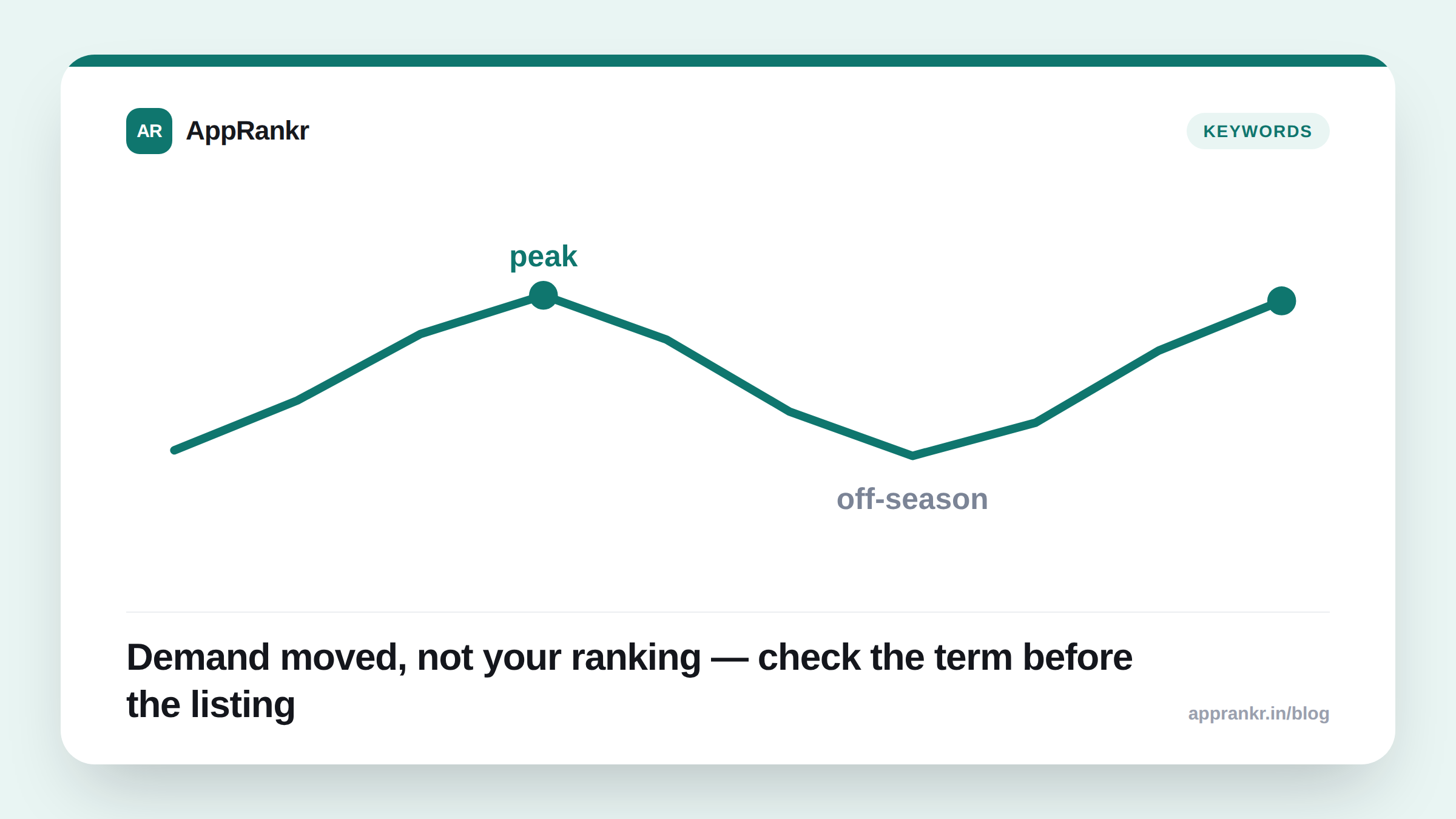
A personal finance app’s “tax saving” keyword sits at rank 60-something for ten months of the year and nobody on the team thinks about it. Then February arrives, search volume for that exact phrase jumps, and the app that was quietly climbing toward page one since December gets the install, while the app that only remembered to care in March is fighting from behind on a term that’s already saturated with sharper, more recently-updated competitors.
This isn’t a hypothetical. Search behavior for whole categories of apps (finance, gifting, travel, fitness, education) genuinely swings by calendar date, and most keyword lists are built once, at setup, with no mechanism for noticing that the terms which matter change through the year.
Why this is easy to miss
A keyword list built during onboarding reflects whatever the app’s core, evergreen use case is: “mutual fund app,” “budget tracker,” “expense manager.” Those terms are stable and worth tracking permanently. Seasonal terms don’t get added the same way, because they don’t feel core to the product. Until the week they suddenly are, by which point the window to build rank on them before the peak has already mostly closed.
| Category | Example seasonal terms | Rough peak window |
|---|---|---|
| Personal finance / tax | ”tax saving app,” “80c investment,” “elss fund” | Jan-Mar (India tax year-end) |
| Gifting / e-commerce | ”diwali gift,” “rakhi gift ideas,” “wedding gift app” | 3-4 weeks before the festival |
| Fitness / wellness | ”new year fitness,” “summer body workout” | Late Dec-Jan |
| Travel | ”monsoon travel deals,” “winter vacation app” | 4-6 weeks pre-season |
| Education | ”exam prep app,” “board exam study planner” | 6-8 weeks before exam season |
The mechanism worth understanding
Nothing here is a claim about how Google Play’s or the App Store’s ranking algorithm specially treats seasonal terms. There’s no confirmed seasonal weighting on either platform. What’s actually happening is simpler and doesn’t need one: the pool of apps competing for a seasonal term is smaller and less optimized in the off-season, so a modest, deliberate push in the weeks before the peak faces less resistance than the same effort would during the peak itself, when every competitor in the category has already turned their attention to the same phrase.
Real-world scenario: Two tax-filing apps both wanted to rank for “tax saving investment” ahead of the Indian tax year-end. App A added the term to its tracked list in December, wrote it into the subtitle in early January, and was sitting at rank 14 by the time search volume actually peaked in February. App B didn’t touch the term until February, when the category was already crowded with apps that had a six-week head start. It never cracked the top 40 for that season, despite arguably having the better product.
Building a seasonal calendar instead of a static list
- Separate your keyword list into “evergreen” and “seasonal” tiers: track both in the same coverage list so history accumulates year over year, but review the seasonal tier on a calendar, not just when volume happens to catch your eye.
- Set a reminder 6-8 weeks before each known peak, not the week of. That’s roughly the window where competitors are still building rank on the term rather than already ranking for it.
- Look at last year’s rank history for the same term, if you have it. A full year of daily-tracked history turns “did our tax-season push actually work” from a guess into a chart you can read.
- Don’t drop a seasonal term from your list after the season ends: a term that goes unranked for ten months and climbs sharply every February is still worth watching year-round; removing it just means re-discovering it from scratch next year.
Most keyword research answers “what do people search for.” Seasonal keywords are a reminder that the better question is often “what do people search for right now, and when does that change.”