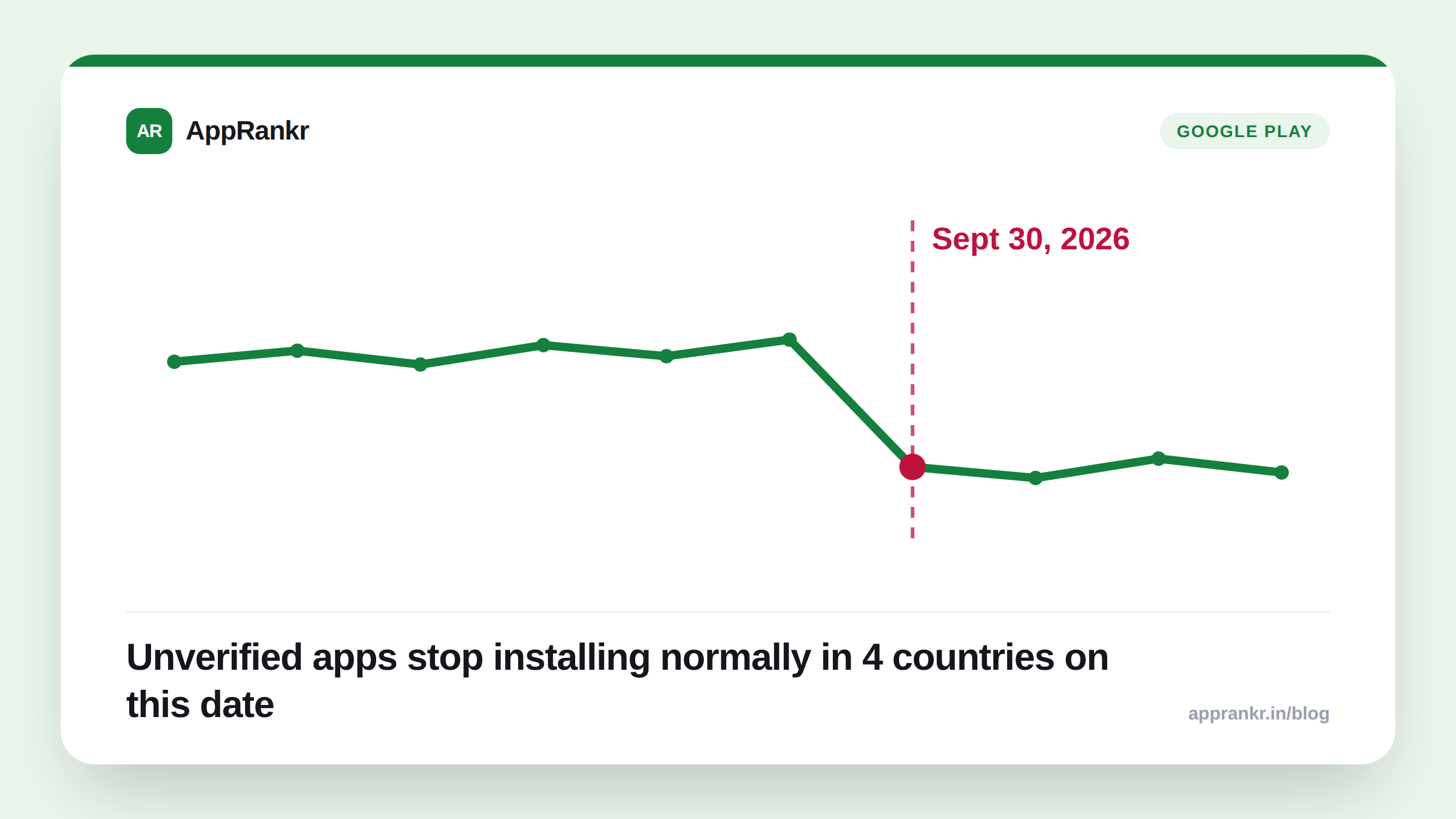
Key points:
- Google’s own Android Developer Verification page confirms regional enforcement starts September 30, 2026, in Brazil, Indonesia, Singapore, and Thailand.
- It applies on certified Android 7+ devices, across Google Play and several other stores. Not Google Play alone.
- Google’s own page says it plans to expand this globally, to all apps on certified devices, in 2027.
- The Hacker News confirms normal installs of unverified developers’ apps get blocked in those four markets on that date.
An app can rank well and still be hard to install. That’s the real risk behind this new rule. It has a firm date attached. Not a vague future plan. Here’s exactly what Google’s own page says, and what it means if your account isn’t set up yet.
What Google’s own page confirms
Google’s developer verification page states the deadline plainly. September 30, 2026. Brazil, Indonesia, Singapore, and Thailand. That date applies on “certified devices running Android 7+” in those countries.
This isn’t a Google Play-only rule. Google’s own list of stores covers:
| Store |
|---|
| Google Play |
| HONOR App Market |
| OPPO App Market |
| Galaxy Store |
| Palm Store |
| V-Appstore |
| GetApps |
An unverified developer’s app can get blocked from a normal install on any of these. On a certified device. In one of the four named countries. Once the date passes.
How verification actually works
Google’s own page names two paths. Sell your app only outside Google Play, and you sign up through the Android Developer Console. Sell on Google Play, and Google Play Console is your route. Google’s own page says that route covers “99% of apps” already there, on its own, with no extra work. A lighter option exists too. Limited distribution accounts. Built for students, teachers, and hobbyists. Up to 20 devices can get an app this way, with no ID and no fee.
The Hacker News adds one more thing worth knowing. A blocked app isn’t gone for good after the deadline. It can still load through Android Debug Bridge, or a slower, awkward path. That path means turning on developer mode, restarting the phone, waiting 24 hours, then confirming again. Nothing like the normal, one-tap install most users expect.
Real-world scenario: A small studio sold their app only through a regional third-party store on the participating list. They assumed Google’s rules didn’t touch them, since they weren’t on Google Play at all. Reading Google’s own page directly showed something different. The requirement covers every store on that list, not just Google Play. Their store was named on it. They registered through the Android Developer Console well ahead of the deadline, instead of finding out the hard way on September 30.
What to actually do before September 30, 2026
- Confirm your verification status now, not the week of the deadline. Google’s own page says most Google Play apps are already covered automatically. Confirm that directly rather than assuming it applies to you too.
- Check whether you sell through any of the other listed stores. This isn’t scoped to Google Play alone. An app on HONOR, OPPO, Galaxy Store, or another store on that list, in one of the four named countries, is in scope too.
- Don’t treat the advanced sideload flow as a real fallback. It exists. But a 24-hour wait and a developer-mode toggle is nothing like a normal install. It will cost you real users.
- Watch for the global expansion Google’s own page names for 2027. The four-country start is explicitly a first phase. Not the final scope.
AppRankr’s Rank Tracker tracks your real Google Play visibility day to day. But a verification block sits underneath ranking entirely. Confirming your account status directly with Google is the one step no ranking tool can replace.