Key points:
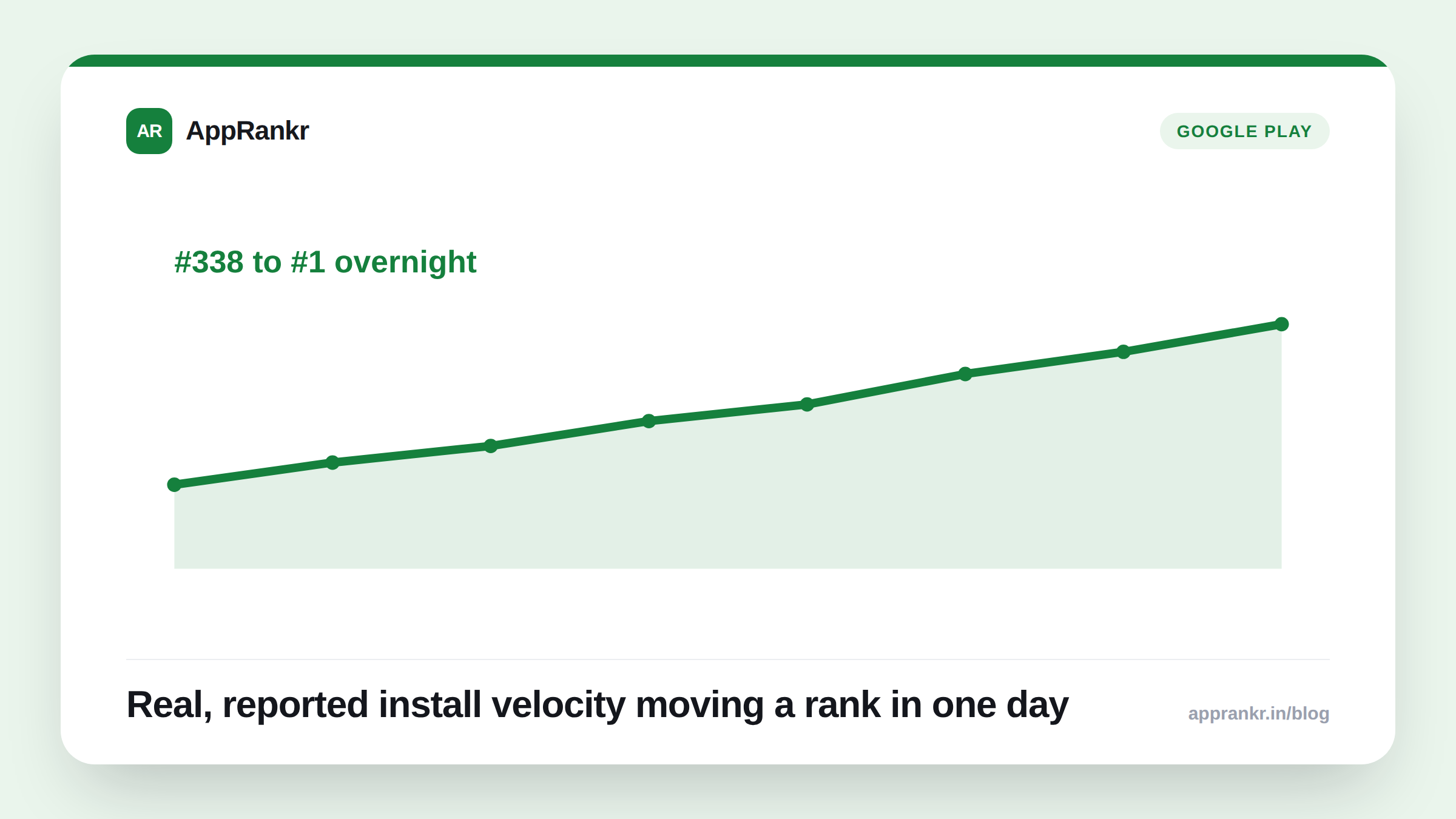
- Reporting places Meta’s Muse app at #338 in its Google Play category in mid-September 2026. Then at #1 the next day. Right after hitting #1 on the US App Store on September 18.
- The app reportedly averaged 55% day-over-day download growth in its first ten days. ChatGPT’s own first ten days reportedly averaged 24%.
- Reporting ties the jump to real organic demand plus Meta cross-promoting the app to its existing Facebook and Instagram users.
- This is a real, current, heavily reported example of install velocity moving a ranking fast. Not a theoretical explanation.
A #338 ranking and a #1 ranking, one day apart. That’s not a typo. It’s what reported, extreme install velocity actually looks like.
What reporting describes happening
Multiple independent outlets tracked the same timeline. Meta’s Muse app launched September 8, 2026. It climbed the US App Store charts over the next days. It reportedly reached #1 there on September 18. The next day, September 19, it reportedly jumped to #1 on Google Play too. Up from #338 in its category just the week before.
| Date | What reporting describes |
|---|---|
| September 8, 2026 | App launches |
| Mid-September | Reportedly #338 in its Google Play category |
| September 18, 2026 | Reportedly reaches #1 on the US App Store |
| September 19, 2026 | Reportedly reaches #1 on Google Play |
Why the jump happened this fast
Reporting points to two things working together. First, real download speed. The app reportedly averaged 55% day-over-day growth across its first ten days. Well above ChatGPT’s own reported 24% average in its first ten days. That’s a steep curve. Not a typical launch pace.
Second, cross-promotion at real scale. Reporting describes Meta marketing the app directly to its own Facebook and Instagram users. The same kind of cross-platform push reported to have helped Threads reach 500 million monthly active users. That’s a reach most teams don’t have. It’s a big part of why the numbers here look the way they do.
Install velocity is the rate an app gains installs in a recent window, measured against competitors. It’s reported as one of the heaviest inputs into Google Play ranking. A spike this steep, held for over a week, is exactly the kind of signal that can move a rank from deep in the list to the very top in one day, once it clears enough competitors’ pace.
Real-world scenario: A smaller productivity app team read about Muse’s jump. At first they assumed the lesson didn’t apply, since they had no large existing audience to cross-promote to. Looking closer at the mechanics here, they saw the real lesson wasn’t about matching that exact scale. It was about install velocity itself being the real lever. They shifted a planned influencer push to launch all at once instead of staggered over a month. That concentrated their own smaller download spike into a tighter window, instead of spreading it thin. Their category rank moved up faster than their past, slower-paced campaigns had managed.
What to actually do about it
- Treat install velocity as a real, measurable lever, not an abstract idea. This case shows exactly how fast a concentrated spike can move a rank when it’s steep enough.
- Concentrate launch pushes into a tighter window where you can. A spread-out trickle of installs doesn’t build the same velocity signal as a real spike.
- Use any real cross-promotion channel you actually have. Most teams don’t have Meta’s reach. But even a smaller audience, an email list, a community, a partner app, adds real velocity when pushed all at once.
- Don’t expect to match this exact outcome. The scale here is unusual. The mechanic behind it, velocity moving rank fast, is the part you can actually use.
AppRankr’s Rank Tracker tracks your category rank and visibility daily, so you can see in real numbers whether a launch push is actually building the kind of velocity spike that moves your ranking.