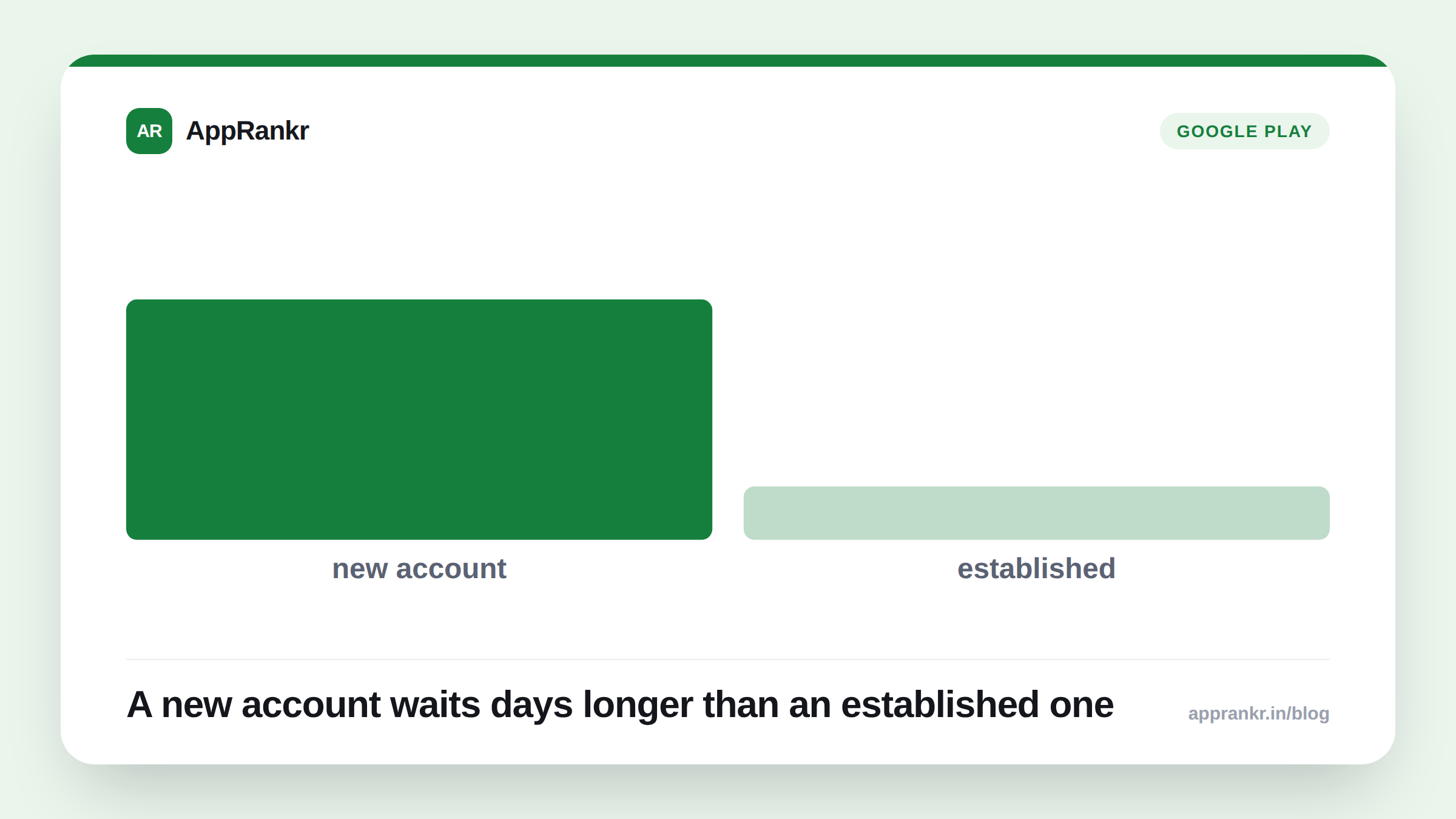
Key points:
- New developer accounts commonly face 7 to 14 days for a first app review. Established accounts with a track record typically clear in 1 to 3 days.
- Most of the added time on a new account goes to identity checks and policy review. Not a deeper technical check of the app itself.
- New personal developer accounts must run a closed test. At least 12 testers, for 14 continuous days, before applying for production.
- That 14-day closed-test window often takes longer than the review itself. It’s a common surprise for first-time publishers.
You submit your first app to Google Play. You expect a quick turnaround. It sits in review for well over a week. That’s not a stuck queue. It’s a real, documented gap between a new account and an established one.
Why the first review takes longer
Google applies extra scrutiny to new developer accounts. Think of it as a trust measure. Reported timelines put a first submission at 7 to 14 days, sometimes longer. An account with a track record of approved apps sees 1 to 3 days instead. Most of that extra time isn’t a deeper look at your app’s code or content. It’s identity checks and policy review. The kind of trust-building step that only applies before an account has any history behind it.
| Account type | Reported review timeline |
|---|---|
| New developer account, first submission | 7 to 14 days, occasionally longer |
| Established account with approved apps | 1 to 3 days |
The testing requirement most new accounts miss
New personal developer accounts face a second gate that’s easy to overlook. Before you can even apply for production access, Google requires a closed test. At least 12 testers. Running for 14 continuous days. That’s not a suggestion. It’s a requirement that sits ahead of the review itself. For a lot of first-time publishers, that 14-day window ends up being the longer wait. Not the review.
Plan for both together. A launch date set without the closed-test window, on top of the review itself, can slip by weeks for a first-time account. An established account skips the closed-test requirement entirely and moves straight to the shorter review window.
Real-world scenario: A first-time developer built their app and planned a launch date two weeks out. They budgeted a few days for Google Play’s review. They hadn’t accounted for the closed-test requirement on new personal accounts. Once they found the 12-tester, 14-day rule, they recruited testers from their own network that same day. They ran the test in parallel with finishing their store listing. The review itself, once submitted after the test window closed, took about a week. Their actual launch landed roughly three weeks after they’d first assumed. Not because of a stuck review, but because the closed-test window hadn’t been part of the original plan.
What to actually do about it
- Start your closed test the moment your account is set up. Don’t wait until the app feels finished. The 14-day clock only starts once testers are actually active.
- Recruit your 12 testers before you need them. Friends, colleagues, or a small beta community all count. As long as they’re genuinely testing, not just accepting an invite.
- Budget 7 to 14 days for the review itself on a new account. Don’t plan a launch date assuming a 1 to 3 day turnaround until your account has an approval history.
- Expect faster reviews on every app after your first. The extended timeline is mainly a new-account cost. Not a permanent one.
AppRankr’s Rank Tracker starts tracking your keyword positions the day your app goes live. You won’t be guessing at visibility during those first uncertain weeks after a longer-than-expected launch.