Key points:
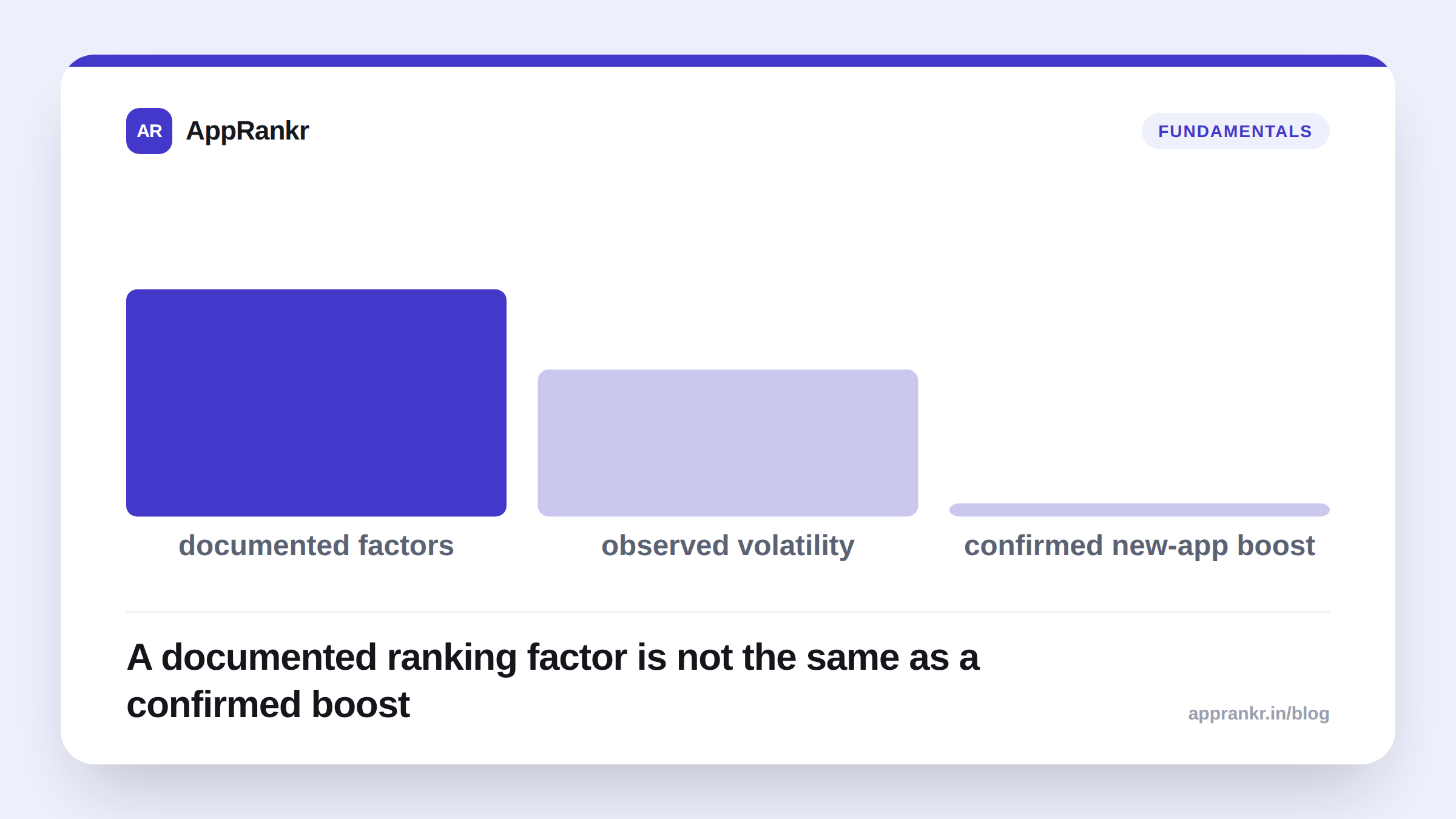
- No official Apple or Google documentation describes a disclosed “new app boost.” Neither platform states this in its developer documentation.
- What gets called a launch boost in ASO vendor content is an observed pattern, not a confirmed algorithm feature. Treat it as anecdotal, not guaranteed.
- Developers report real visibility volatility for new and small apps on Apple’s own developer forums. Sometimes dramatic swings. That volatility is a real, documented complaint, even without a confirmed cause.
- A more likely explanation than a hidden boost: with so little history yet, a handful of installs or reviews can swing a new app’s numbers far more than the same activity would for an established app.
You launch. A few days in, you notice another new app. One you genuinely think is worse than yours. It’s sitting comfortably in search results. Your own app is nowhere. The obvious question follows. Is there a new-app boost? Did you somehow miss out on it? Here’s the honest answer, not the confident-sounding one.
What’s actually documented: nothing
We checked Apple’s own developer docs, its App Store Connect Analytics reference, and Google Play’s app discovery and ranking pages. None of them describe a disclosed visibility boost for new apps. That’s not a gap in this article’s research. It’s a real absence in what either company publishes.
What you’ll find instead, across ASO vendor blogs, is a repeated claim. New apps supposedly get some kind of temporary lift. Often lasting a few days to a few weeks. These claims come from vendors watching patterns across many apps. Not from anything Apple or Google has confirmed. That gap matters if you’re deciding whether to treat “wait for the boost” as a real strategy.
What developers are actually reporting
Real visibility swings for smaller apps ARE documented. Just not with a confirmed cause. On Apple’s own dev forums, one thread titled “Shadow-banned by design” describes an app going from 2 daily downloads to 300. Then back down to a couple the very next day. No changes made on the dev’s side. Another older thread raises a similar complaint. Apps seeming to lose rank for reasons that don’t match anything in their own listing.
These are real reports of instability. They show that visibility for smaller, newer apps can swing hard either way. They are not proof of one specific, confirmed boost working for or against you.
| What’s documented | What’s not |
|---|---|
| Ranking varies by device, location, and time, even for established apps | A specific new-app boost window or duration |
| Developers report real visibility swings for small apps | A confirmed cause for those swings |
| Metadata relevance and user feedback are named ranking factors | Any special early-life weighting of those factors |
The more likely explanation
Here’s a simpler theory. It needs no hidden algorithm feature to explain what you’re seeing. A brand-new app has almost no history. A handful of installs. A couple of genuine good reviews. A small cluster of real searches landing on your listing. Any of these can move your numbers by a large percentage, purely because the base number was so small to begin with. An app with two years of history absorbs that same small burst of activity without it moving anything visibly.
What looks like “the algorithm rewarded that other new app” might just be normal signal, amplified by a tiny base number. It looks dramatic. It needs no secret rule to explain it.
Real-world scenario: Two similar habit-tracking apps launched within a week of each other. One climbed into visible search positions for its core keywords within four days. The other stayed flat for three weeks. The slower team assumed they’d missed some early-launch window. They compared notes with the faster app’s developer. The real difference was simpler. The faster app had pre-launched a landing page. It collected around 200 people who installed and left a genuine review within the first 48 hours. The slower app had zero pre-launch audience. It picked up its first reviews organically, one at a time, over three weeks. Once the slower app crossed a similar review count, in week four, its visibility climbed at a comparable rate. No boost expired or arrived for either app. The review velocity difference explained the whole gap.
What to actually do in the first days
- Don’t wait for a boost that isn’t confirmed to exist. Treat your first weeks as normal, gradual signal-building, not a countdown.
- Front-load genuine reviews if you can. A pre-launch waitlist or beta group that installs and reviews honestly in your first days gives you real signal early, when it moves the needle most.
- Get your title, description, and first screenshot right before launch, not after. Early signal compounds on top of whatever your listing already communicates.
- Track your actual keyword positions daily from day one. A real climb or a real stall then shows up as data, not a feeling.
AppRankr’s Rank Tracker is built for exactly this. Watching your new app’s actual keyword positions from the first day. So you know whether you’re climbing, flat, or genuinely stuck, instead of guessing from a competitor’s apparent luck.