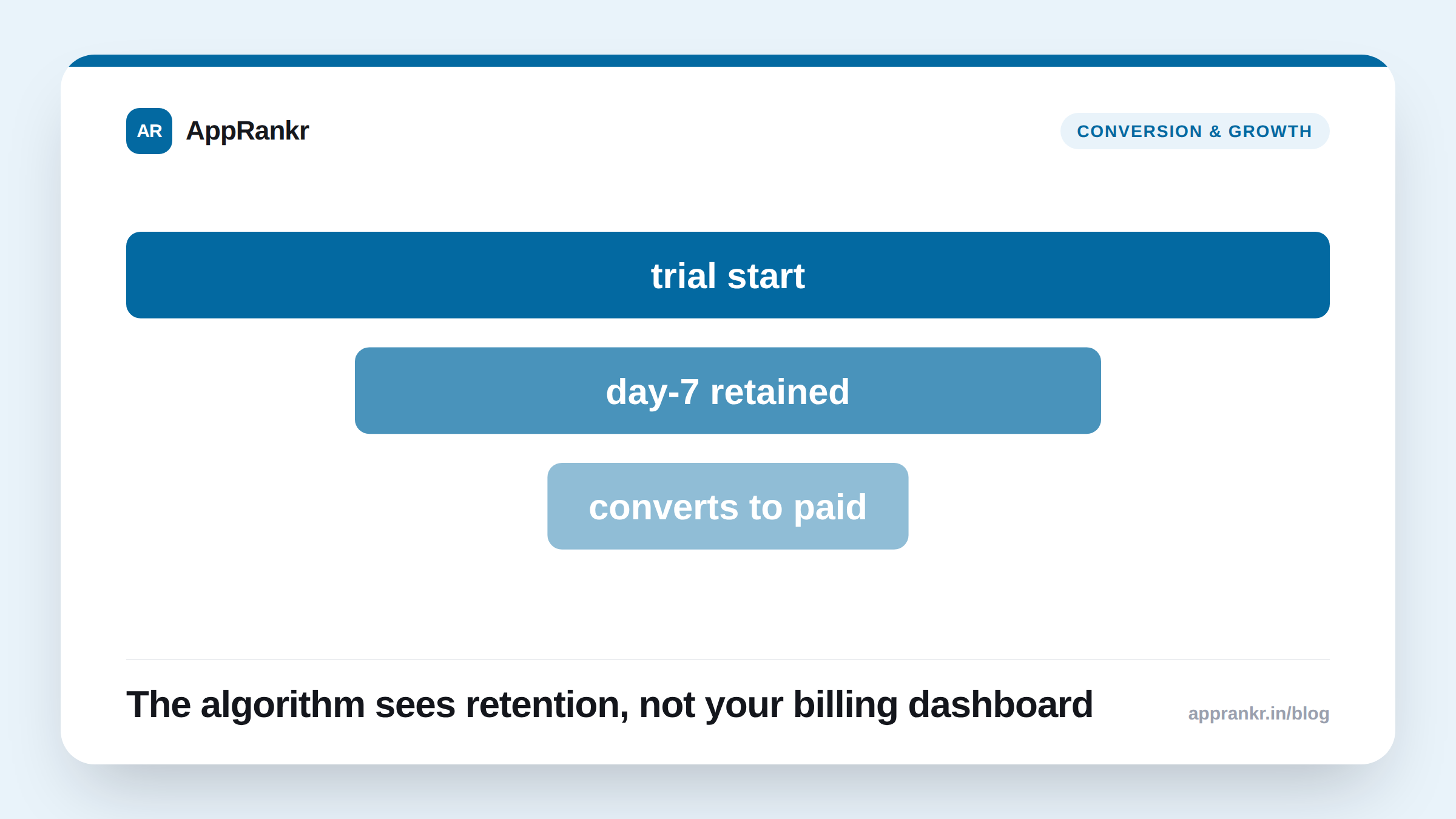
Subscription teams optimize hard for one number: trial-to-paid conversion. It’s the metric that decides whether the business works. But it’s worth being clear-eyed about something, the app store algorithm never sees that number. It has no access to your billing system, your subscription funnel, or your churn dashboard. What it sees instead are proxies, retention, engagement, and rating, that your conversion work usually also moves, but not on the same timeline, and not for the same reason.
What the algorithm sees vs what your dashboard shows
| Your business dashboard | What the store can actually observe |
|---|---|
| Trial start rate | Install rate (a rough upstream proxy) |
| Trial-to-paid conversion rate | Retention/uninstall behaviour during the trial window |
| Post-conversion churn | Rating and review sentiment, especially right after the trial length |
| Lifetime value | Not visible to the store at all |
None of this means conversion work is wasted on ASO, it means the ranking benefit arrives through a different door than the metric you’re actually optimizing for.
Churn right after a charge is a rank problem, not just a revenue one
A spike in uninstalls or a cluster of 1-2★ reviews landing right after a trial converts to a paid charge is a specific, recognizable pattern, and it’s a common one for subscription apps: “forgot to cancel,” “charged without warning,” “didn’t realize this wasn’t free.” That cluster shows up in the store’s rating and review data as a quality signal, even though the actual cause is a billing-communication problem, not an app defect. The store doesn’t distinguish “the app is bad” from “the billing experience surprised people”, it just sees a rating dip and reads it as one.
Retention during the trial window specifically
Day-3 and day-7 retention during the trial correlates strongly with eventual paid conversion, and it also happens to be exactly the kind of engagement signal stores read as a ranking input. This is the closest thing to a direct bridge between your business metric and an actual ranking signal, a trial flow that keeps people engaged in the first week is doing double duty: it’s building the conversion number you care about, and it’s building the retention signal the algorithm cares about, at the same time.
Real-world scenario: A meditation app improved trial-to-paid conversion by 8% through onboarding changes that got users into their first session faster. Ranking didn’t move for nearly two weeks afterward, not because the change didn’t work, but because the app’s trial length was 7 days, so the retention signal reflecting the new onboarding didn’t fully populate until roughly that long after the change shipped, plus the store’s own lag on top of it. The metric and the rank reaction were both real, they just ran on different clocks.
Reviews are doing double duty here
For subscription apps specifically, reviews often litigate the billing experience as much as the product itself, surprise charges and cancellation friction are recurring complaint themes in a way they simply aren’t for a one-time-purchase app. It’s worth watching rating velocity in the days clustered just after your typical trial length, not only the all-time average, since that’s exactly when “forgot to cancel” complaints tend to land together.
What to actually do
- Track keyword rank and trial-to-paid conversion as separate charts, not one blended story, conflating a business metric with a ranking metric hides what’s actually happening to either one.
- Watch rating velocity specifically in the window right after your trial length ends, not just the running average, that’s where billing-related complaints cluster first.
- Run an ASO audit on your listing’s trial/subscription terms, check whether expectations are set clearly before the store’s review climate sets them for you.
- Track competitors in your subscription category on shared keywords, subscription verticals (meditation, fitness, finance) cluster tightly, and a rival’s pricing or trial-length change can shift review sentiment sitewide, not just for them.
The store will never read your subscription dashboard. But it’s reading the retention and review trail your subscription flow leaves behind, closely, and on its own schedule, not yours.