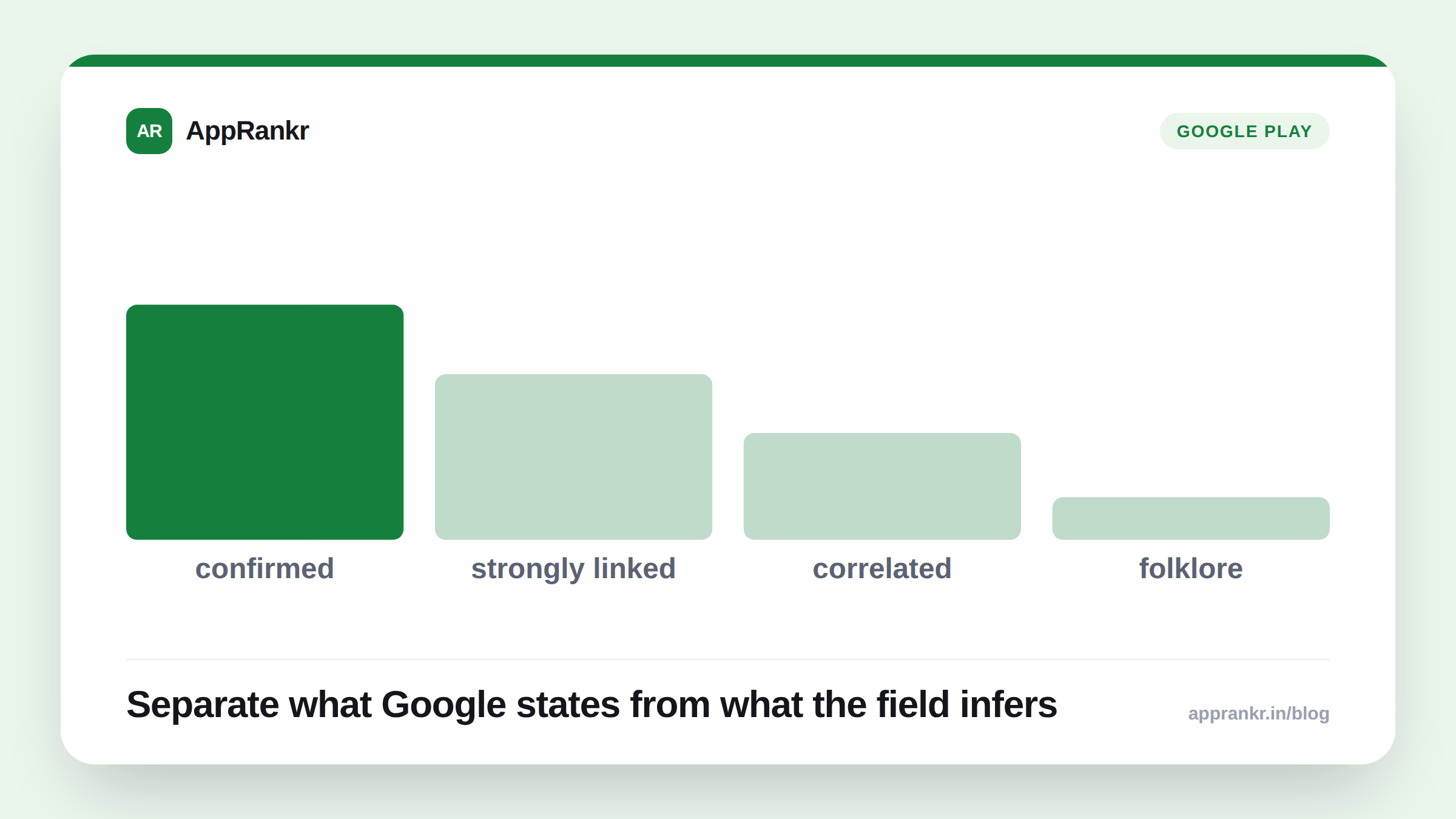
Every “Google Play ranking factors” article you’ll find online (including this one) is working from the same limited set of sources: Google’s own developer documentation (which describes policy, not ranking weight), patent filings, official statements from Google’s own team at conferences, and large-scale observed testing by ASO practitioners tracking rank changes against known variables.
Nobody outside Google has the formula. What follows is organized by confidence level, because treating a strong inference the same as a confirmed fact is how ASO folklore gets started and never dies.
Confirmed by Google directly
Keyword relevance in the title, short description, and long description matters, in that rough order of weight. Google’s own Play Console help documentation explicitly recommends including relevant keywords in all three fields and states that the title carries the most weight. This is about as close to “confirmed” as ASO gets.
There is no separate hidden keyword field on Android, unlike iOS. Every word you want indexed has to live in visible listing text. This changes strategy meaningfully versus iOS. See our iOS vs Android ASO piece for the full comparison.
Google explicitly penalizes keyword stuffing and misleading metadata. This is stated policy, with real enforcement. Apps have been suspended for titles or descriptions that string together irrelevant popular terms purely to rank.
App quality signals feed into ranking, including crash rate, ANR (app-not-responding) rate, and Android vitals thresholds. Google has said outright that a technically poor app is suppressed in Play Store search and browse, independent of how well-optimized its listing text is.
Strongly inferred from large-scale testing
Install velocity and retention correlate with rank, but the causal direction is genuinely debated even among people who’ve run large tests. Do installs cause rank, or does rank cause installs, in a loop that’s hard to isolate? Most practitioners now treat this as an outcome signal that reinforces itself rather than a lever you push directly. You improve retention by improving the product, and rank tends to follow with a lag.
Recency of updates has some positive effect, though it’s smaller than commonly assumed and easy to overstate. Shipping a changelog-worthy update roughly matters more for retention and rating recovery than for a direct rank bump.
Rating average and rating velocity (how many recent ratings, not just the all-time average) both matter, and a sudden spike in 1-2★ reviews appears to correlate with a measurable rank drag within days to weeks, not months. This is exactly why we build a rating trend into the dashboard here. A slow negative slide is often visible weeks before it shows up as a rank drop, giving you a window to fix the root cause first.
Real-world scenario: A file-sharing app’s 1-2★ share climbed from 9% to 19% over three weeks after a buggy update, no listing changes, no keyword changes. Its rank for its top keyword slid from #6 to #19 in that same window, then recovered to #8 within ten days of a bugfix release. Nothing about the listing text ever changed; the entire swing tracked the rating-quality signal.
Category and store-front localization affect what “relevant” means. An app correctly categorized and with a properly localized listing for a given country/language pair tends to out-rank an identical listing that’s only in English, for searches made in that other language.
Widely believed, weakly supported
“Backlinking” or external SEO signals influencing Play rank: there’s no credible evidence for this, despite it circulating in some ASO circles. Play Store search is a closed system; it isn’t Google web search.
A specific “sweet spot” character count for descriptions: advice varies wildly between sources with no consistent methodology behind the specific numbers quoted. Write a description that’s genuinely useful to a reader and covers your real feature set; don’t optimize for an arbitrary word count some blog post claimed works.
Exact numeric weights for any individual factor (e.g. “title is worth 30%, retention is worth 25%”). Anyone stating precise percentages is guessing. The relative ordering (title matters more than long description) has reasonable support; the specific math does not.
Confidence summary
| Factor | Confidence | What to actually do |
|---|---|---|
| Title/subtitle/description keyword relevance | Confirmed | Optimize deliberately. This is the safest place to spend effort |
| No hidden keyword field on Android | Confirmed | Every target keyword must live in visible listing text |
| Keyword stuffing penalty | Confirmed | Avoid it. It’s policy, not folklore |
| App quality (crash/ANR rate) | Confirmed | Fix stability before chasing copy changes |
| Rating average + rating velocity | Strongly inferred | Watch the trend, not just the snapshot |
| Install velocity/retention | Strongly inferred | Improve the product; rank tends to follow with a lag |
| Update recency | Strongly inferred | Matters more for retention/rating recovery than a direct rank bump |
| Backlinking / external SEO | Weakly supported | Don’t spend effort here. Play Store search is a closed system |
| Exact numeric factor weights | Weakly supported | Ignore anyone quoting precise percentages |
What this means practically
Since nobody. Including every ASO tool on the market. Has the actual formula, the only trustworthy approach is:
- Optimize the things Google has explicitly confirmed matter (title/subtitle/description keyword relevance, avoiding stuffing, app quality/stability).
- Track your own rank over time for the specific keywords you care about, so you have real, first-party evidence of what worked for your app. General advice about “the algorithm” is never going to be as reliable as your own before/after data.
- Treat everything below “confirmed” as a hypothesis to test, not a rule to follow blindly.
That third point is the one most guides skip, and it’s the most useful one. If you change your title and your rank for that keyword improves over the next two weeks, you’ve learned something true about your app, in your category, in your market. Which is worth more than any general claim about “the algorithm,” including the ones in this article.