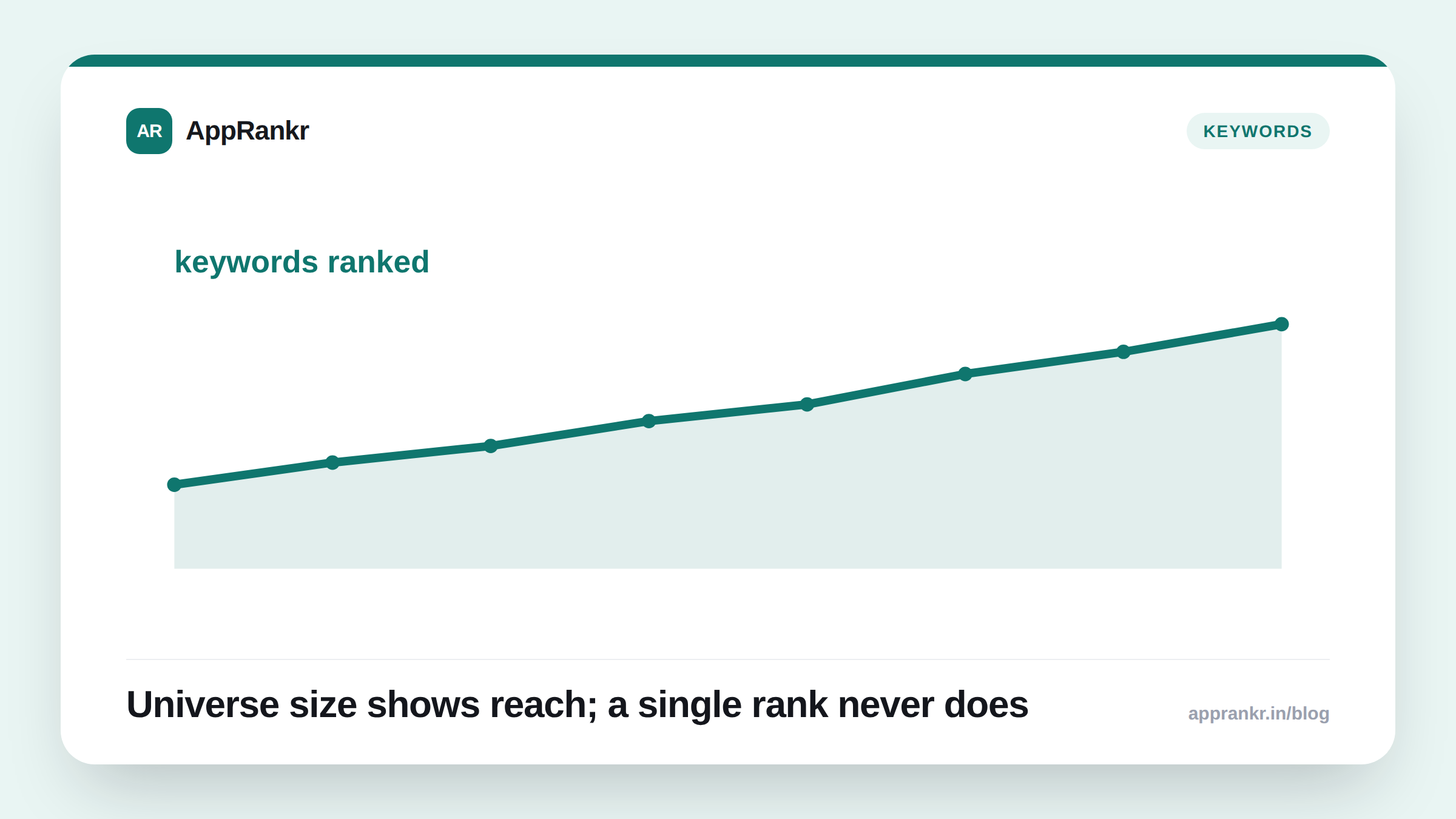
Ask someone how their ASO is going and they’ll tell you about rank: “we moved up 6 spots on our main keyword.” That’s a real, worthwhile thing to track, but it answers a narrower question than most people realize. It tells you how you’re doing on the terms you already decided mattered. It tells you nothing about whether the list itself is still growing, or quietly stalled months ago.
Two very different failure modes
A keyword list can look “healthy” on rank charts while being unhealthy in a way rank charts can’t show: flat size. If you added 40 keywords when you first set up tracking and haven’t added a single one since, every rank chart you look at is measuring your performance against a snapshot of your own research from months ago. While the actual language real searchers use has kept moving.
The reverse also happens and is just as easy to miss: a list that’s technically growing but growing in the wrong direction, padded with near-duplicate variants of terms you already track, rather than genuinely new territory.
| What you’re measuring | What it tells you | What it misses |
|---|---|---|
| Rank on existing keywords | Is our optimization work paying off on terms we already chose | Whether we chose the right (or enough) terms in the first place |
| Keyword universe size over time | Is our research effort keeping pace with the market | Nothing on its own. Pair it with rank, don’t replace rank with it |
Why this is the metric that answers “am I falling behind”
Search vocabulary in any app category drifts constantly, new feature names enter the language, competitors coin phrases that catch on, seasonal terms cycle in and out. A keyword list that stopped growing in March is implicitly assuming nothing about how people search has changed since March. That assumption gets more wrong the longer it goes unchecked, and rank data alone can’t flag it, because rank data only ever reports on the terms already in the list.
Real-world scenario: Two competing budgeting apps both showed stable, respectable rank on their tracked terms across a full quarter. Nothing alarming on either dashboard. The difference only showed up in list size: App A’s tracked universe had grown from 60 to 140 terms over the quarter, picking up “cash envelope method,” “shared budget app,” and a dozen other phrases that had entered real search behavior. App B’s list was still the same 55 terms from setup day. App B’s rank numbers looked fine in isolation, and were quietly becoming a smaller and smaller fraction of the actual conversation happening in its own category.
Making list growth something you actually watch
- Chart your keyword universe’s size over time, not just its rank. A flat line here is itself the finding, even before you look at any individual keyword’s position.
- Re-run keyword discovery on a schedule, not just once at setup. The store’s own autosuggest and your competitors’ listings are moving targets, worth re-scanning periodically rather than treating as a one-time research task.
- Watch competitor listings for language you don’t have yet: a rival adopting a new phrase in their description is an early signal worth adding to your own universe, before it becomes obvious in search volume data.
- Treat “no new keywords found” as a prompt, not a null result: if research keeps turning up nothing new, that’s either genuinely a mature, well-mapped category, or a sign the research method itself has stopped working and needs a different seed (new competitor set, new autosuggest queries, a fresh look at your own feature roadmap).
Rank tells you how you’re doing on the map you already drew. Universe size tells you whether you’re still drawing the map at all.