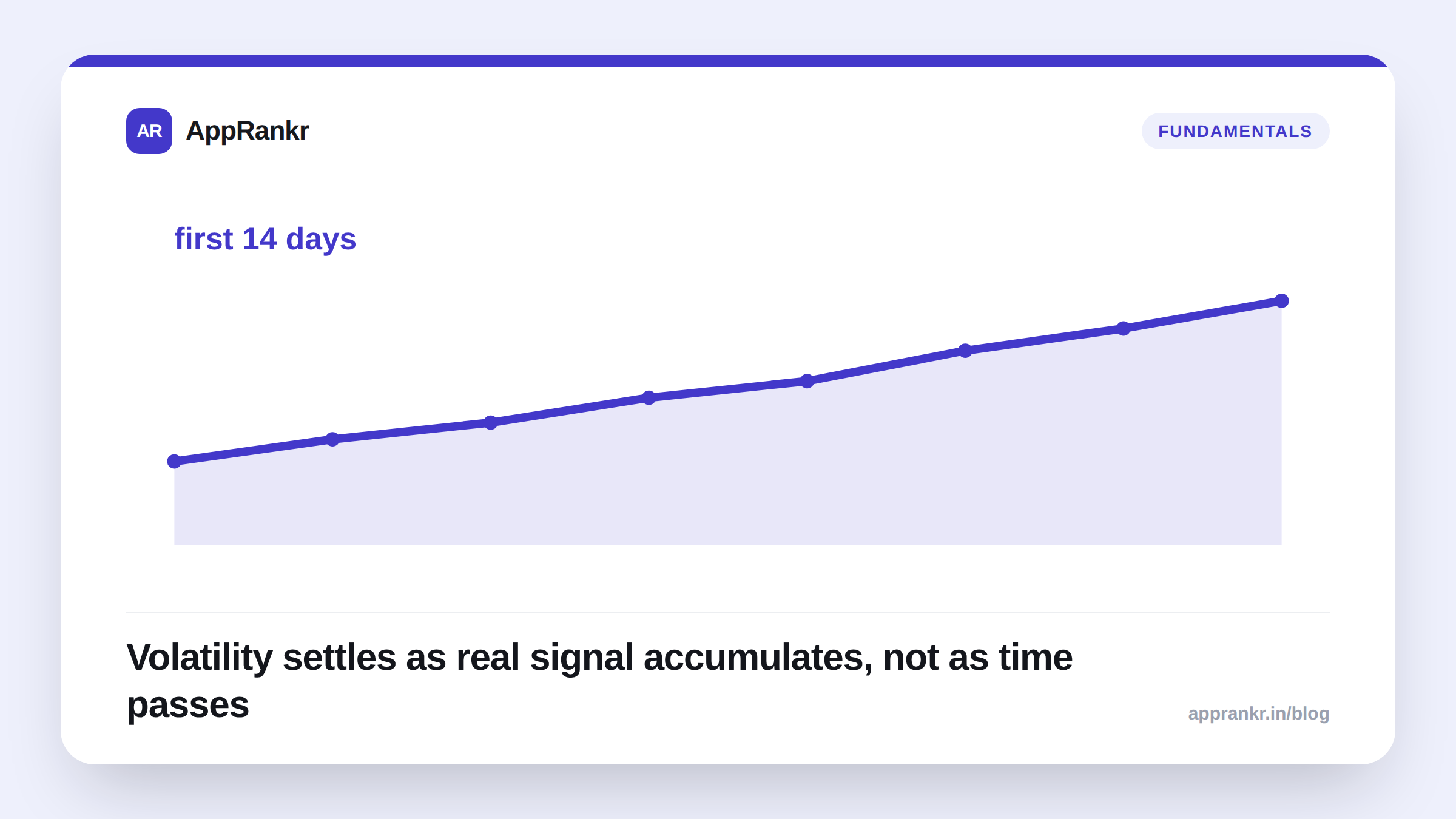
A new app’s rank chart in the first two weeks looks alarming if you’re used to reading an established app’s trend: big swings, a keyword ranked #8 one day and unranked the next, a category position that seems to reset overnight. None of that is a mistake on your part. It’s what happens before either store has enough signal about your app to rank it with any confidence, and it resolves on its own faster than most teams expect, if you know what to actually watch instead of the noise.
Why the volatility is expected, not a problem
Both stores’ ranking systems weight signals your app hasn’t produced yet on day one: install velocity, rating average and count, retention, conversion rate on the listing itself. An app with zero history doesn’t get ranked on a blank slate, it gets a provisional position that gets revised, sometimes sharply, as each of those signals starts accumulating real data. A rank that moves from #40 to #12 to #25 in the first ten days isn’t three different judgments about your app’s quality, it’s the same evolving judgment being revised as more evidence comes in.
| Week | What’s typically happening | What to watch |
|---|---|---|
| 1 | Highest volatility. Little to no rating/retention data yet, ranking is mostly provisional | Whether installs and first ratings are coming in at all |
| 2 | Early rating average forms, retention data starts to exist | Rating trend direction, not just the raw average yet |
| 3-4 | Rankings start reflecting real signal instead of provisional placement | Whether specific keyword ranks are trending, not just moving |
| 4-6+ | Typically closer to a stable trend, assuming steady installs/ratings | Whether the trend matches your actual optimization work |
What to actually check during this window
Are installs coming from real, relevant intent? A spike from a source that doesn’t retain (incentivized installs, mismatched paid traffic) can hurt more than help, since both stores read post-install behavior, not just the raw count, as retention feeds directly into the quality signals ranking weighs.
Is your early rating trend positive, even at low volume? The same arithmetic that makes 100 new ratings barely move an established app’s average works in reverse for a new app: your first 20-30 ratings carry outsized weight on the average precisely because there’s no history yet to dilute them. A rocky first week of reviews is worth fixing fast, before volume makes the average harder to move.
Are your title/subtitle/description actually indexed the way you intended? New listings occasionally have indexing lag distinct from rank volatility, confirm what’s actually indexed rather than assuming a missing keyword rank means a ranking judgment rather than an indexing delay.
Real-world scenario: A newly launched expense-tracking app watched its top keyword swing from unranked to #14 to unranked to #22 across the first nine days, and the team nearly paused their launch marketing spend, assuming something in the listing was broken. Nothing was. Daily install volume was steady and ratings were trending positive (4.6★ across the first 40 reviews). By day 19 the keyword had settled at a stable #17 and stayed within a few positions of that for the following month. The volatility had fully tracked the pattern of a new listing accumulating signal, not a listing problem.
What not to do in week one
- Don’t rewrite the listing in response to early swings. Changing title, subtitle, or keywords while the ranking is still provisional means you can’t tell whether a later move was caused by your edit or by the normal settling process, and you lose your clean baseline for reading it.
- Don’t judge the app against an established competitor’s rank position. They have months or years of accumulated signal behind their number, a direct comparison in week one is comparing against a different kind of number entirely.
- Don’t treat day-to-day movement as a trend until you have at least 1-2 weeks of daily history to look at. A tracker that logs daily position history turns “is this actually settling or still random” into something you can see on a chart instead of guessing from memory of yesterday’s number.
The first two weeks are the store forming an opinion, not delivering a verdict. Track daily, keep the listing stable while it settles, and judge the trend once there’s enough history to call it one.