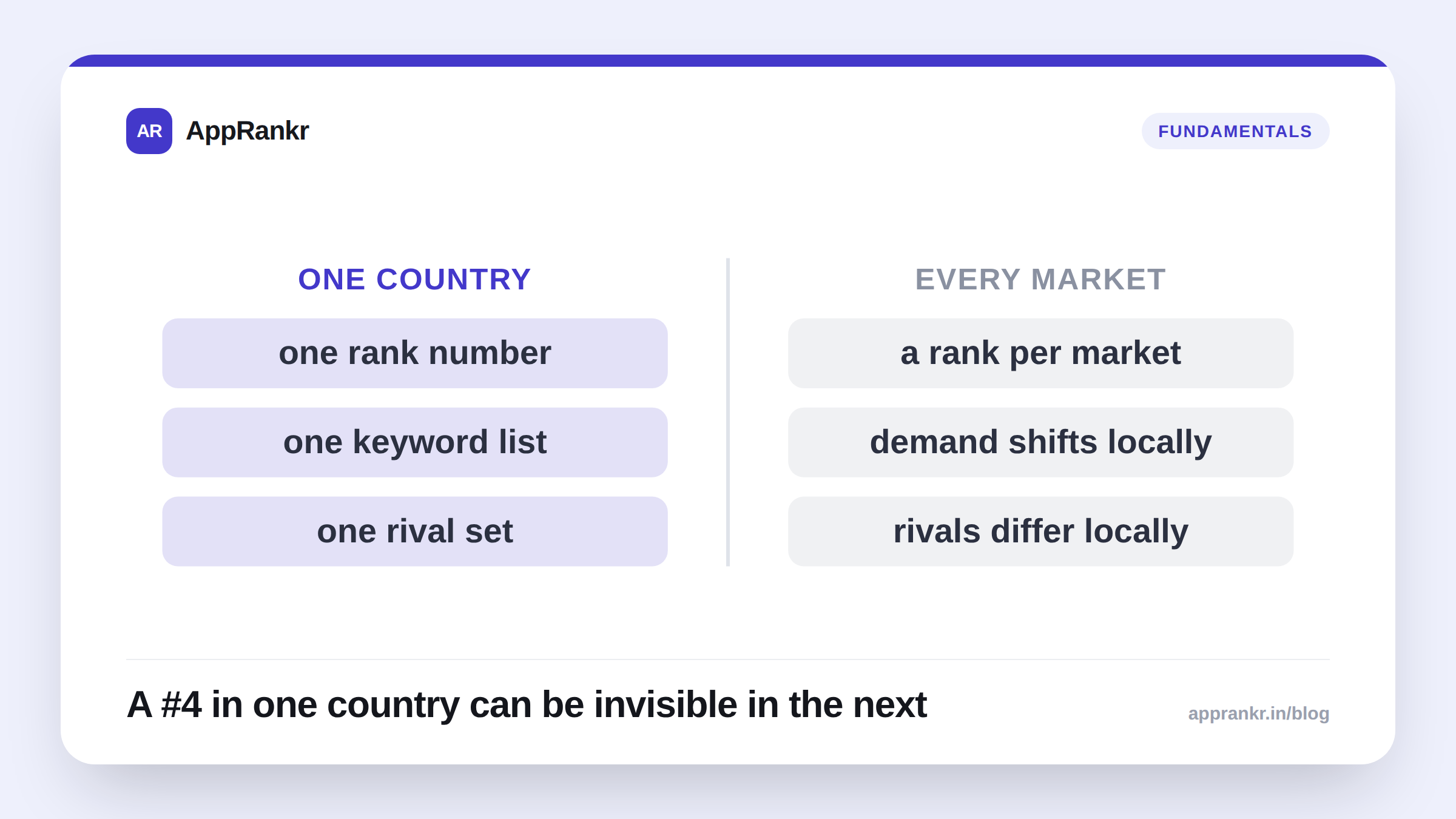
Most teams start tracking one country, usually wherever the app first launched, and quietly assume that number represents how the app is doing everywhere else it’s listed. It doesn’t. Google Play and the App Store both compute rank per country, not globally, so the exact same app, same keyword, same day can be a confident #4 in one market and an invisible #180 in another. If you’re only watching one storefront, you’re watching one market’s opinion and calling it the whole picture.
The store computes a separate rank per country, not one global number
There’s no single “how does my app rank” answer, there’s a different answer for every country/storefront combination you’re listed in, because each one runs its own search index against its own local traffic and its own local competitor set. A US ranking tells you nothing directly about your UK ranking, your India ranking, or your UAE ranking, they’re computed independently, even though it’s the identical build and identical listing text behind all of them.
| Same across every market | Different in every market | |
|---|---|---|
| App quality (crash rate, ANR rate, build) | Yes, same binary everywhere | — |
| Overall rating value | Mostly, ratings are typically pooled globally per store | — |
| Keyword demand and phrasing | — | Yes, driven by local search behaviour |
| Competitor set | — | Yes, who else shows up for that term locally |
| Actual keyword rank | — | Yes, computed independently per storefront |
Keyword demand isn’t the same list, just translated
A head term that’s brutally competitive in the US can be nearly wide open in a secondary market, not because the algorithm treats it differently, but because fewer relevant apps are actively targeting it there yet. The inverse happens too: a term that barely registers as search volume at home can be a genuinely high-demand phrase somewhere else, driven by different habits, different payment norms, or a locally dominant use case your home-market research never surfaces. Building one keyword list and assuming it transfers, even after translation, misses this entirely, demand shifts by market, not just language.
Your competitors change by market too
The apps you’re actually up against for a given keyword are a local list, not a global one. A fintech app’s biggest US rival might not even be listed in India, while the app actually eating its India rank for the same keyword may be a name it’s never heard of at home. Tracking competitors deliberately, per market, rather than assuming “our usual rivals” holds everywhere, is the only way to know who you’re genuinely losing a keyword to in a given country.
Real-world scenario: A budgeting app tracked only its home US market for months, watching overall visibility hold roughly flat. After adding its India listing to tracking, a keyword search revealed a term climbing 40 positions over six weeks there, nowhere near visible in the US data, because the US view had never included that market at all. The improvement had been real the whole time; it just wasn’t in the one country being watched.
What actually does stay the same
It’s not that everything is local. App quality signals, crash rate, ANR rate, and the underlying build’s stability, are the same app everywhere, so a fix that improves them helps every market’s ranking, even though the rank number itself never transfers between countries. The mistake isn’t tracking one market carefully, it’s assuming that market’s trend explains what’s happening everywhere else you’re listed.
What to actually do
- Track each market you’re actually live in separately (add each country/storefront to Rank Tracker) rather than treating one country’s number as a stand-in for the rest.
- Build a keyword list per country from local demand, not a translated copy of your home-market list, research it fresh per market.
- Identify your real competitor set per market (track them deliberately), since “who’s beating us” is a different answer in every country.
- Don’t over-read a global quality metric as a market-specific ranking explanation, crash rate helps everywhere; a keyword rank move in one country is usually a local story.
A multi-market app that only watches one storefront isn’t wrong about that storefront, it’s just missing every other conversation happening about it, in every other market where it’s live.