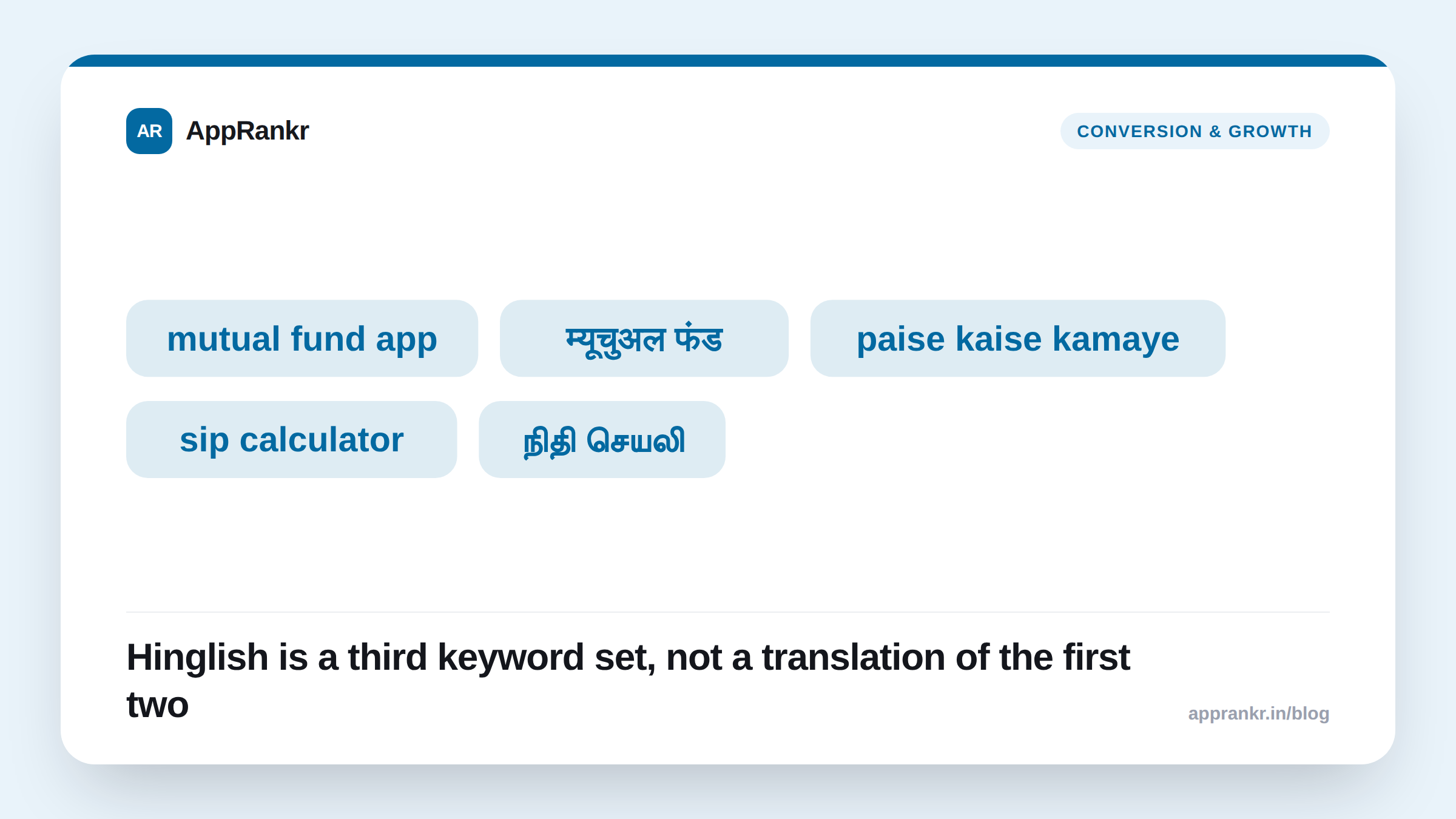
India is usually treated as a single market to localize for, “add Hindi” and move on, but that undersells both the opportunity and the risk of getting it wrong. A large share of how Indian users actually search doesn’t look like formal Hindi or plain English, it looks like Hinglish, and a listing that misses it is invisible for an entire category of real queries.
The three layers worth localizing for
| Layer | What it looks like | Why it’s separate from the others |
|---|---|---|
| English | Your existing listing | Still the right default for metro, English-first users, don’t remove it |
| Hindi (Devanagari) | Formal Hindi script | Matches users who search in native script, a real and distinct segment |
| Hinglish | Hindi words in Roman script, mixed with English | How a large share of India actually types, missed entirely by the other two |
| Regional languages | Tamil, Telugu, Bengali, Marathi, and others | Under-served by most competitors, a real opportunity where you have regional user density |
Hinglish is the layer most listings skip entirely
Store search is largely keyword-matching, not semantic understanding of intent. A user typing “paise kaise kamaye” isn’t matched by a listing that only contains “earn money” in English or “पैसे कैसे कमाएं” in formal Hindi, it’s a third, distinct string. If a meaningful share of your target users are typing in Hinglish (common across finance, shopping, and utility apps in particular), a listing that skips it is missing real search volume, not a marginal amount.
Build the keyword list from how people actually search, not a translation pass
The wrong approach is to write your English keyword list first, then hand it to a translator. That produces grammatically correct Hindi that doesn’t match real search behavior. The better approach: research what people actually type, in whichever script, for the intents your app serves, treating Hinglish as its own keyword set rather than a translation of the English one. Keyword research that accounts for volume, not just plausibility, matters just as much here as it does for English keywords, a Hinglish phrase that sounds right but that nobody actually searches doesn’t help you.
Regional languages are where competitors usually stop
Most apps that localize at all stop at Hindi. That makes Tamil, Telugu, Bengali, Marathi, and other regional languages a genuine opportunity if your user base has real density in those states, less competition for the same discoverability gain. This isn’t worth doing everywhere, it’s worth doing where your actual users are, which is a call your install-geography data can make for you.
Trust signals matter here just as much as keywords
Localized text gets a user to your listing. What convinces them to install is a separate question, and for certain categories it matters even more locally. See our piece on trust signals for fintech apps for how this plays out specifically where users are evaluating whether to hand over financial information, a context where a well-localized but under-trusted listing still underperforms.
Real-world scenario: A consumer app tracked its Play Store keyword rankings across English, Hindi, and Hinglish variants of the same core terms separately. The English variant was ranking respectably. The Hinglish variant of the exact same intent wasn’t ranking at all, because the listing had never included that phrasing anywhere in the title, subtitle, or description. Adding a handful of Hinglish terms to the subtitle and description (not a full rewrite) moved that variant from unranked into the top 20 within two weeks, a segment of search demand the listing had simply never been visible to.
What to actually do, in order
- Research Hinglish search terms separately from English and formal Hindi, don’t assume a translation covers it.
- Add Hinglish and Hindi keywords into your title, subtitle, and description, not just a translated app description buried below the fold.
- Check your install geography for regional-language opportunity before investing in a language your actual users don’t speak.
- Track each language variant’s keyword rank separately, a rank tracker that lets you track keywords by exact phrase will show you whether the Hinglish or regional version is actually ranking, which an English-only view can’t tell you.
- Pair localization with trust signals for sensitive categories, translated text alone doesn’t close the trust gap that drives the actual install decision.
India’s search behavior isn’t one language, it’s several layered together, and a listing that only covers English or only covers formal Hindi is leaving real, searchable demand on the table.