Key points:
- Industry reporting ties localized screenshot text to real conversion gains in non-English markets. Often a double-digit percentage range. Not an official Apple or Google statistic.
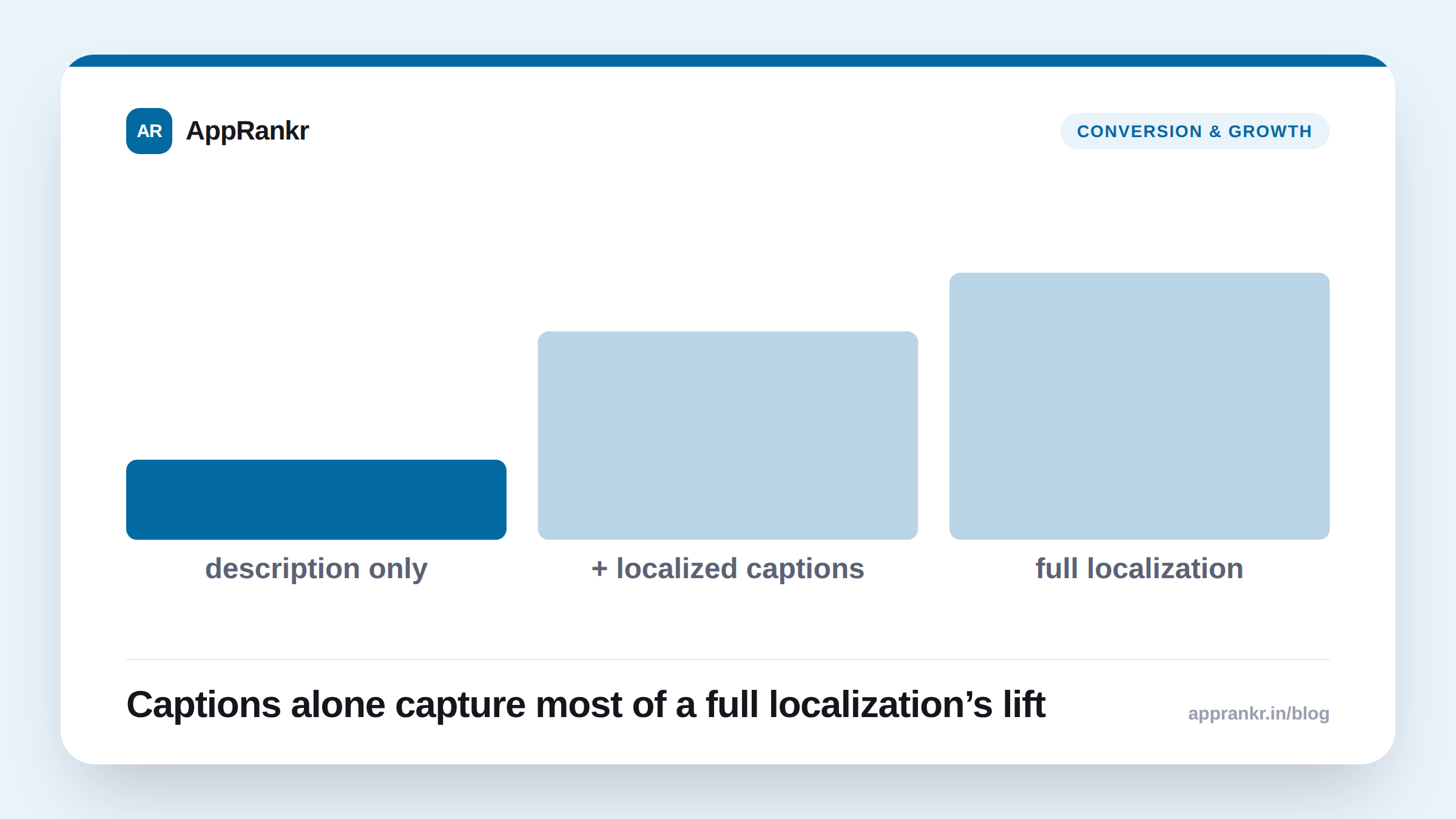
- Reporting says screenshot captions alone capture a large share of the lift from a fully localized listing. Even without translating the rest of the page.
- The reported strongest practice: adapt the actual message in each caption. Not just the words. A literal translation of an English hook often undersells the point.
- Reporting says start with your top 5 markets by revenue. Not every supported language at once.
Most localization work starts with the description text. And stops there. Industry reporting says the bigger, faster win sits somewhere teams check last. The words sitting right on the screenshots themselves.
What’s reported, and what isn’t
No official Apple or Google page publishes a stat for “localized screenshots increase conversion by X%.” But a pattern shows up again and again across independent ASO reporting. Screenshot caption localization in non-English markets ties to real gains. Often double-digit ones. Captions alone are reported to capture a large share of what a full listing localization would deliver.
| Localization step | What reporting says |
|---|---|
| Translate the description only | Smaller, real lift |
| Localize screenshot captions | Bigger reported lift, often most of the total |
| Full listing localization | Highest reported ceiling, more work to do |
Treat any single percentage here as an industry guess. Not a number the platforms confirm. But the direction holds steady across sources, even where the exact numbers don’t match.
Why captions do more work than a translated description
A shopper scanning search results in their own language sees your screenshots first. Before they read a single word below them. If those images still carry English text, the real pitch never lands. No matter how well the text reads underneath. Reporting points at one strong practice here. Adapt the message itself for each market. Don’t just swap the English words for local ones. A joke, a turn of phrase, or a pitch that lands in English can fall flat translated straight across. Even when the grammar comes out perfect.
Real-world scenario: A subscription app translated its full app store description into eight languages. They expected a broad conversion lift. The lift showed up. Smaller than the team expected, though. Reading industry reporting on screenshot localization pointed at the likely gap. Every screenshot still carried the original English captions, in every market. They rewrote captions for their top 5 revenue markets first. They adapted the actual message instead of translating line for line. The next conversion check showed a bigger jump than the description translation alone had produced.
What to actually do about it
- Localize screenshot captions before you finish the rest of the listing. Reporting says this one step captures a large share of the lift on its own.
- Start with your top 5 markets by revenue. A caption rewritten well for one real market beats a thin translation spread across many.
- Adapt the message, not just the words. A word-for-word translation can lose the actual point. Write the caption fresh for that market instead.
- Treat any specific percentage as reported, not confirmed. Track your own before-and-after numbers in each market. Don’t assume an outside figure applies to your app.
AppRankr’s ASO Inspector reviews your current listing’s copy and creative. Check whether your screenshots still carry English text in a non-English market. Worth doing before you invest in a full translation pass.