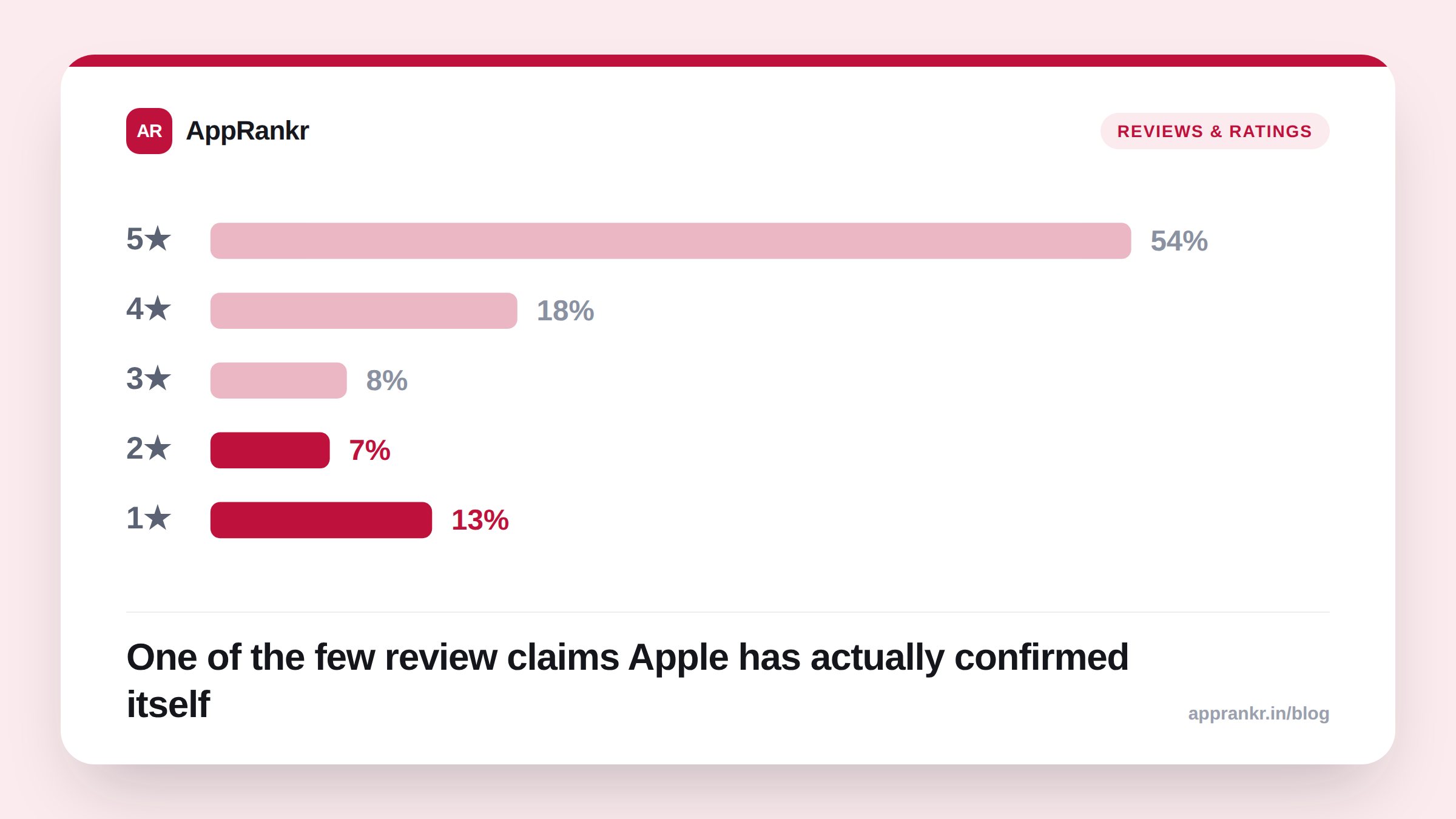
Key points:
- Apple’s own ratings and reviews guidance directly ties responding to reviews to a better rating and to discoverability. Not a vague, unsourced tip.
- Responses go through App Store Connect. Either the web dashboard directly, or Apple’s own Customer Review Responses API for teams managing this at scale.
- Apple doesn’t publish an exact ranking weight for review responses. The claim is real. The size of the effect isn’t quantified anywhere public.
- This is one of the few review-related claims in ASO that’s actually confirmed in Apple’s own words. Not just long-running practitioner consensus.
A lot of ASO advice about reviews turns out to be practitioner consensus, not something Apple has actually stated. Review responses are a rare exception. Apple’s own guidance says this one directly. Worth knowing exactly what it says, and what it stops short of promising.
What Apple’s own guidance actually says
Apple’s ratings and reviews page says plainly that addressing feedback on your page can help create a better user experience. It goes further. It ties that to improving your rating. And mentions discoverability and downloads in the same breath. That’s a real, sourced claim. Not a guess passed around ASO forums for years.
This puts review responses in a small, useful group. A ranking-adjacent move Apple has actually confirmed itself. Most review advice, like the exact weight of one 1-star review, has no such backing.
How to actually respond, mechanically
Apple gives you two real paths. The App Store Connect web page, where you reply to reviews by hand. Or Apple’s own Customer Review Responses API, built for teams managing this at scale, or wiring review handling into their own support tools. Both are real, current parts of App Store Connect.
Neither path is hard to set up. The harder part is a real process. Who reads reviews, and who decides what’s worth a reply. Not the act of posting one.
| Question | What Apple’s own docs confirm |
|---|---|
| Does responding to reviews help your rating? | Yes, stated directly in Apple’s guidance |
| Is it tied to discoverability too? | Yes, mentioned in the same guidance |
| Is there a documented ranking weight for this? | No specific number published |
| Can you respond through an API at scale? | Yes, via App Store Connect’s API |
What Apple stops short of saying
Apple doesn’t publish a number here. No stated ranking weight, no threshold for how many responses move the needle, no timeline for when a rating shift shows up. The claim is real and directly sourced. The size of the effect stays undocumented. Treat “responding to reviews helps” as confirmed. Treat any specific percentage a vendor attaches to it as their own estimate, not Apple’s.
Real-world scenario: A meal-planning app had a habit of reading reviews but never replying, on the assumption that responses were mostly for show. After finding Apple’s own guidance on this, the team set up a simple weekly process. Someone read new reviews, replied to ones raising a real, fixable complaint, and flagged bugs to the engineering team from that same list. Several users who’d left a 2-star review edited it upward after getting a direct, specific reply addressing their exact issue. Their overall rating average moved up slightly over the following weeks. Their keyword rankings held steady, which tracked with Apple’s own framing of this as a rating and experience lever, not a keyword one.
What to actually do with this
- Set up a real, recurring process for reading and answering reviews. Not a one-off cleanup pass.
- Prioritize responses to reviews that raise a specific, fixable issue. That’s where a reply is most likely to change a user’s mind.
- Use the API if you’re managing review responses across several apps or markets. Apple’s own endpoint supports that at scale.
- Don’t expect a specific percentage lift. Apple confirms the direction of the effect. Not a number to promise anyone.
AppRankr’s Rank Tracker watches your actual rating trend over time, so you can see whether a real response habit is moving the number that matters.