Key points:
- A user scanning your IAP list spends the most attention on whatever shows up first.
- This is a separate decision from how many purchases you list at all.
- Leading with your highest price isn’t automatically the right call if a new user has no context for it yet.
- The order itself is a real lever most teams never set on purpose.
Most teams pick their in-app purchase order by default, often just the order they built the purchases in. That’s a real decision sitting there unmade.
Why position does real work here
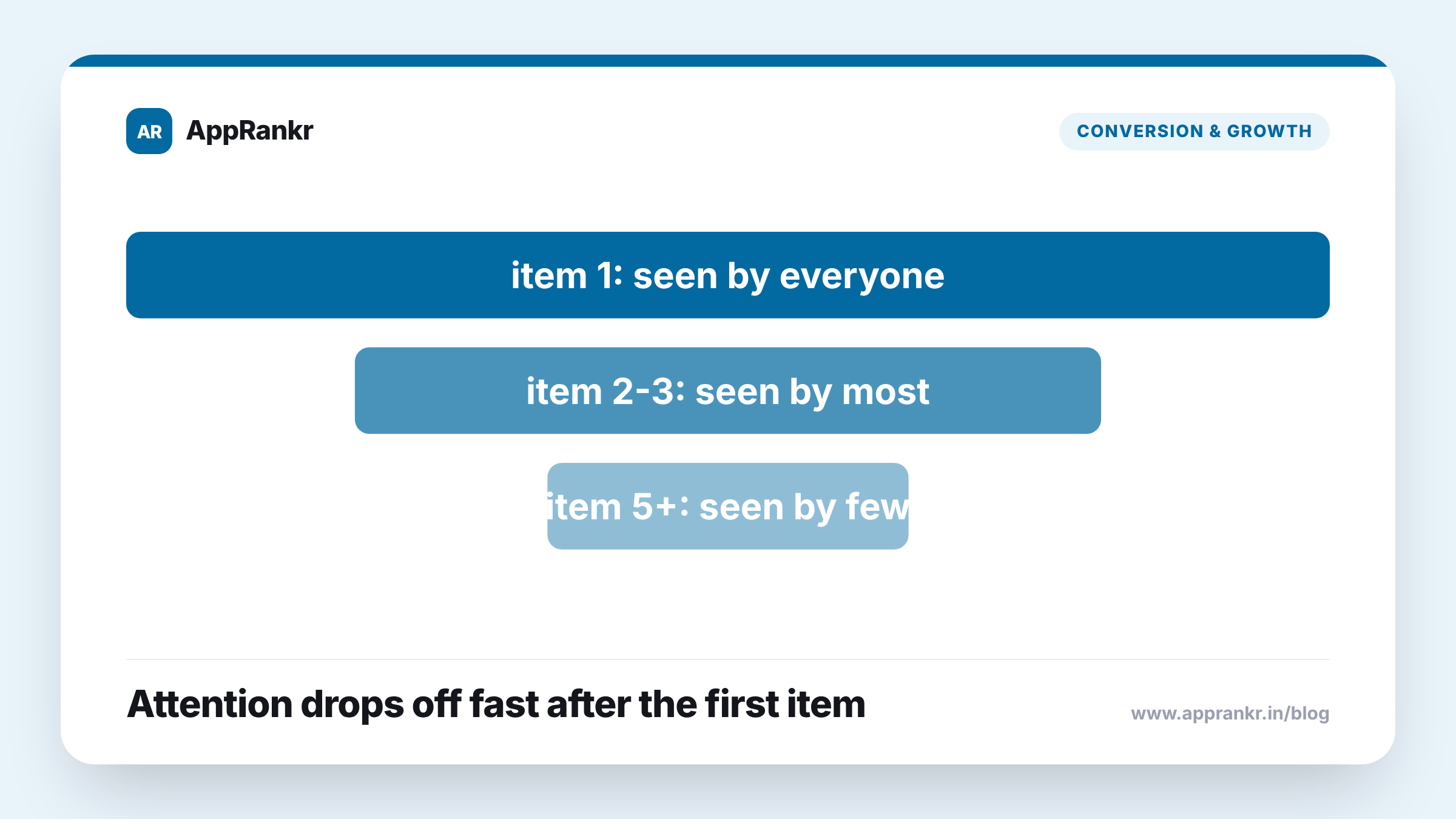
A user scrolling a list of purchases doesn’t weigh every item equally. The first one gets looked at by everyone who opens the list at all. The fifth one only gets seen by whoever’s still scrolling by then. That’s a real difference in attention, independent of which purchase is actually your best or most profitable one. An IAP’s position in the list is doing work whether or not anyone chose it on purpose.
| What gets the most attention | |
|---|---|
| First item in the list | Seen by everyone who opens it |
| An item several rows down | Seen only by whoever keeps scrolling |
Why this isn’t the same decision as how many you list
How many purchases you show affects how crowded or focused the whole list reads. Order is a different lever entirely. It decides which specific item inside that list is doing the most work for you. You can have a short, focused list with the wrong thing leading it, or a long list with the right thing leading it. The two choices, count and order, are worth making separately rather than assuming one fixes the other.
Real-world scenario: A team’s IAP list led with their highest-priced bundle, assuming it made sense to put their best offer first. New users, who had no context yet for why that bundle was worth it, mostly scrolled past without buying anything. Reordering the list to lead with a smaller, easier-to-understand purchase, with the bundle positioned further down for returning users who’d built context, measurably improved overall purchase conversion using the exact same set of items.
What to actually do about it
- Decide your IAP order on purpose, not by build sequence. Whatever’s first gets the most attention by default.
- Lead with whatever’s easiest for a brand-new user to want immediately. That’s often not your highest-priced option.
- Treat order and count as two separate decisions. Fixing one doesn’t automatically fix the other.
- Test a reorder before assuming your current lineup is right. The same items in a different order can convert differently.
AppRankr’s ASO Inspector checks your real listing signals, a useful way to see whether your purchase lineup is actually working the way you assumed.