Key points:
- App Intents is Apple’s framework for exposing specific app actions to Siri, Spotlight, and Shortcuts through one shared system.
- Apple’s WWDC 2026 session on the framework details concrete implementation steps: entity indexing, structured search, “onscreen awareness,” and donating user interactions so Apple Intelligence learns real usage patterns.
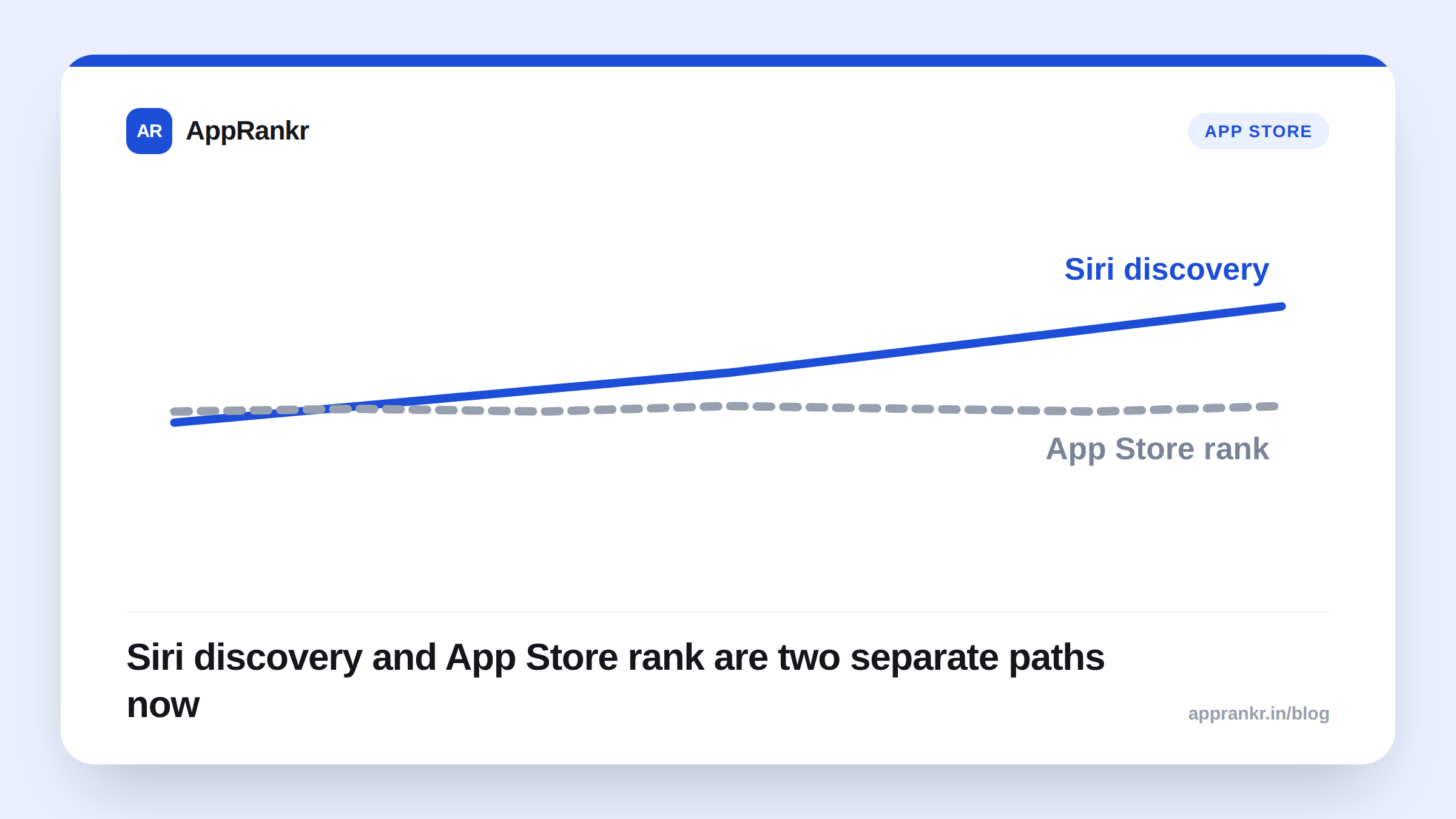
- This is a separate discovery path from App Store search. It’s about a specific in-app action getting surfaced by Siri, not your app’s listing getting ranked.
- Apple introduced a broader Siri AI, built on Apple Intelligence, in June 2026, with app discovery as one of its stated goals.
App Store search ranks your listing. App Intents does something else. It can get one single action inside your app noticed by Siri. Or found through Spotlight. Not your whole app. Just one thing it does. That’s a separate way to get found, and most ASO advice doesn’t cover it yet.
What App Intents actually does
App Intents is a tool Apple gives developers. It lets an app describe what it can do to the rest of iOS. Without it, you’d build one link to Siri, another to Spotlight, and a third to Shortcuts. With it, you describe your app’s actions once. Apple’s own page says it plainly: one shared way in, not three separate jobs.
Apple’s WWDC 2026 talk on the tool lays out real, specific pieces:
| Piece | What it does |
|---|---|
| Content indexing | Makes specific things in your app, not just the app, easy to find system-wide |
| Structured search | Lets Siri search content too big or too dynamic to fully index |
| Onscreen awareness | Lets someone say “play the third one” about whatever’s on your screen right now |
| Usage donations | Feeds real usage patterns back so Apple Intelligence learns how people actually use your app |
None of this changes your App Store search rank. It’s a different path. Getting found and used through Siri and Spotlight, sometimes with no App Store step at all.
Why this is worth paying attention to now
Apple rolled out a new, smarter Siri in June 2026, built on Apple Intelligence. Better app discovery was one of the goals it named. As Siri gets better at understanding what people want, an app that has properly described its own actions has a real shot at being the one Siri picks. An app that skipped that work just isn’t part of the conversation at all.
Real-world scenario: A habit-tracking app ranked well in its category, but had never set up App Intents. A user asked Siri to “start my morning routine,” expecting the app to respond. Nothing happened. The app had never told the system that action existed. The team later added one App Intent for starting a saved routine. App Store rank didn’t move at all. But the app started showing up somewhere new: as a direct answer to a spoken request.
What to actually do with this
- Treat this as separate from App Store ASO, not a swap for it. Keyword rank and App Intents solve two different problems.
- Start with your app’s single most common action. Apple’s own guide starts with one thing done well, not everything at once.
- Read Apple’s own page before trusting a summary. Apple’s App Intents documentation is the real source. Treat any outside stat about it as unproven until you check it yourself.
AppRankr’s ASO Inspector covers your App Store listing. App Intents is the discovery channel sitting next to it, worth understanding even though it isn’t something a store-listing audit can measure directly.