Key points:
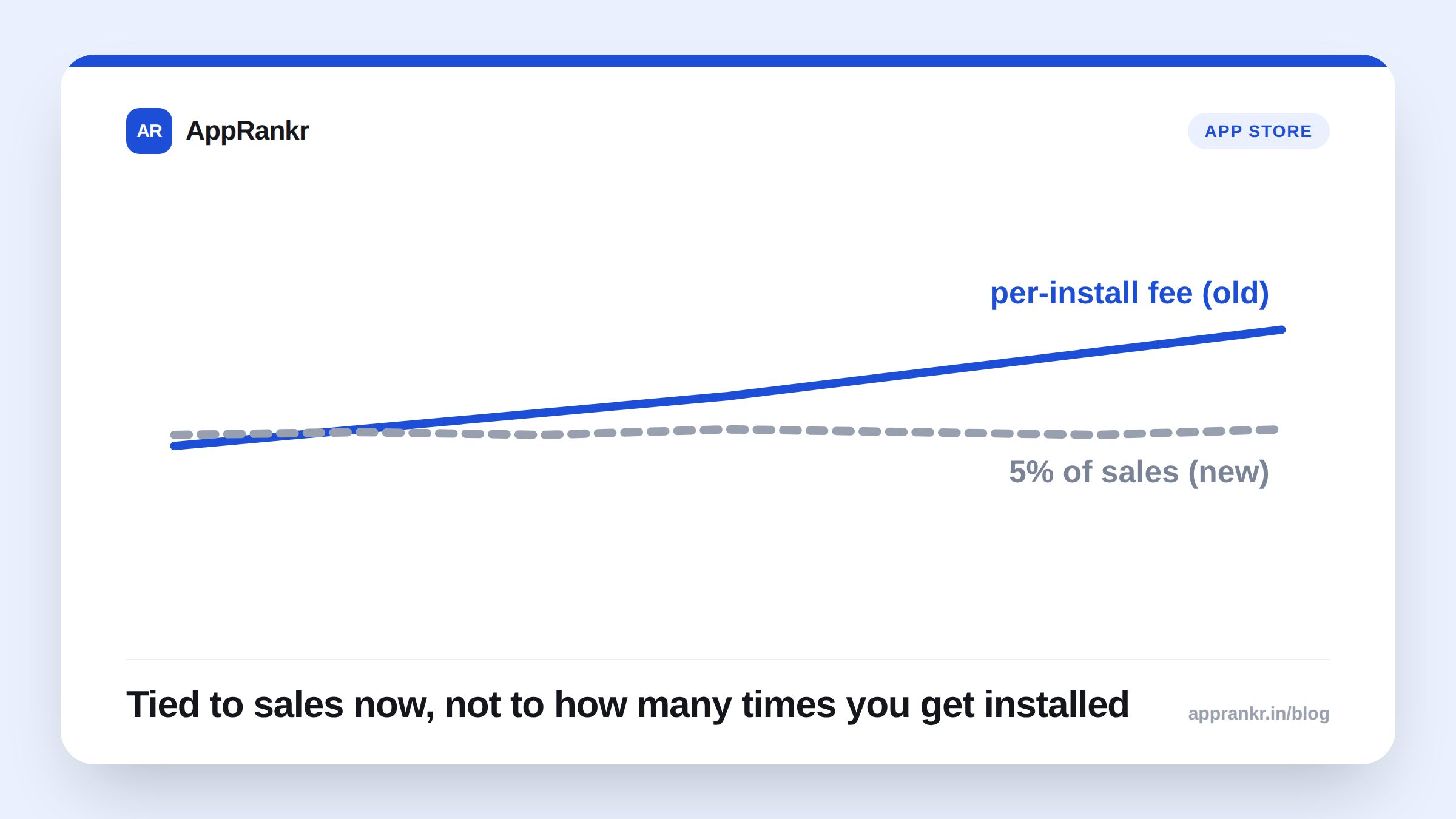
- Apple’s own August 2026 announcement confirms the EU’s per-install Core Technology Fee is ending. Not adjusted. Fully replaced.
- The old fee charged 0.50 euro per install or annual update. That kicked in once an app passed 1 million EU installs in 12 months.
- The new charge is a flat 5% commission on digital transactions. Only in apps distributed through alternative marketplaces or the web. Tied to sales, not installs.
- The change starts October 1, 2026. It applies to the EU only. It’s separate from Apple’s similarly named commission in Brazil.
A fee tied to installs punishes growth itself. A fee tied to actual sales doesn’t. That’s the real shift in Apple’s EU announcement. Not just a smaller number.
What’s actually changing
The old EU fee charged 0.50 euro for every install or annual update. That started once an app crossed 1 million installs in the EU within a year. A free app that suddenly went viral could rack up a real bill. With zero revenue behind it. That’s the exact problem this change removes. Per Apple’s own August 2026 announcement, the per-install fee ends October 1, 2026. In its place: a flat 5% commission on digital transactions. Only inside apps distributed through alternative marketplaces or the web, in the EU.
| Detail | Old fee | New fee |
|---|---|---|
| What it charges | 0.50 euro per install/update | 5% of digital transaction value |
| What triggers it | Crossing 1M EU installs a year | An actual sale happening |
| Risk to a free, viral app | Real cost, no revenue | No cost without a sale |
| Effective date | Being phased out | October 1, 2026 |
Why this matters beyond the number itself
A per-install fee and a percentage-of-sales fee behave very differently as an app scales. The old model meant a download spike, even on a free app with no purchases, could generate a real bill. The new model only charges when money actually changes hands. A free app with no in-app purchases can now go viral in the EU at zero cost on this fee. Under the old model, that same spike carried real risk.
This is a separate program from Apple’s Core Technology Commission in Brazil. Even though the name and the 5% rate look similar. Brazil’s version follows its own settlement and terms. Don’t assume the two match just because the numbers do.
Real-world scenario: A small studio with a free EU app had been budgeting for the per-install fee. They worried a successful marketing push could trigger real charges with no matching revenue. After Apple’s August 2026 announcement, they recalculated their EU cost model around the new 5% transaction-based commission. Their app had no in-app purchases at all. The recalculation showed a viral spike would now cost them nothing on this specific fee. They redirected the budget they’d set aside for per-install charges into extra EU marketing spend instead.
What to actually do about it
- Recalculate your EU cost model for October 1, 2026 onward. A budget built around the old per-install fee no longer reflects reality.
- Check whether you distribute through an EU alternative marketplace or the web. This 5% commission applies there. Not to standard App Store sales through Apple’s own payment system.
- Don’t confuse this with Brazil’s Core Technology Commission. Same name, same rate, separate program with its own terms.
- Revisit any decision you made to avoid EU growth because of the old fee. A free app with no purchases carries none of that install-based risk now.
AppRankr’s ASO Inspector helps you get the most out of every install you do pay to acquire, regardless of which fee structure applies to your app in a given market.