Key points:
- Apple’s own App Privacy Details page requires more than a dozen self-declared data categories on every app. A real, mandatory field, not optional text.
- One academic study found that well over half of apps checked still lacked a label months after Apple’s own deadline passed. Adoption was slow, not instant.
- A separate audit found real accuracy problems in how labels get filled in. Self-reported doesn’t always mean correct.
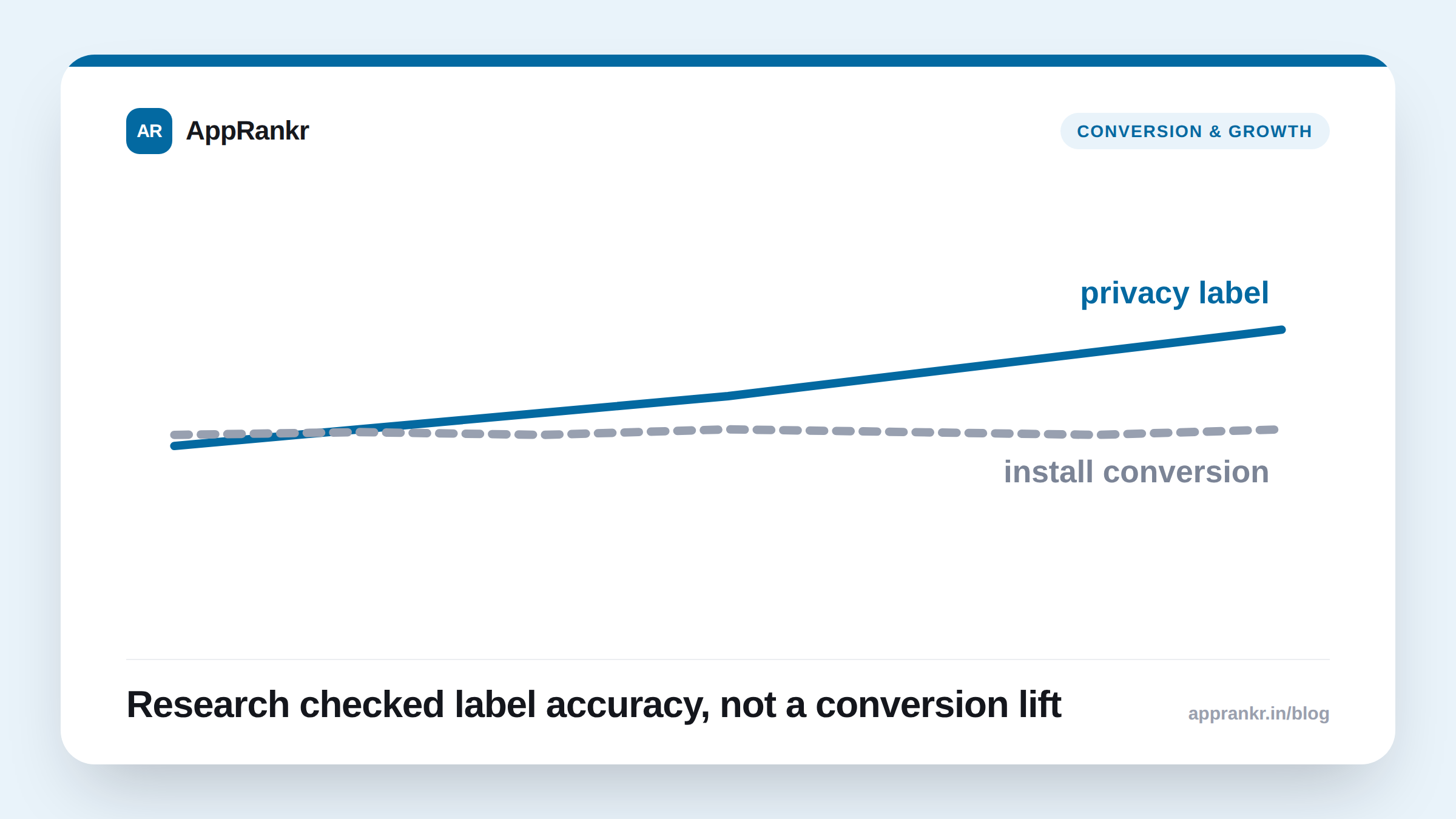
- No public study proves a clean, accurate label directly lifts your install conversion rate. That specific claim is still unproven, not confirmed fact.
Privacy labels get pitched constantly as a conversion lever. Fill yours in well, the pitch goes, and trust goes up, so installs go up too. That’s a reasonable guess. It’s not the same as a proven, measured result. Worth knowing exactly where the real research actually lands.
What Apple actually requires
Apple’s own App Privacy Details page lays out a real system. More than a dozen data categories. Self-declared by you. Shown right on your App Store page. This part is fully confirmed. Every app must fill it in.
Apple’s page does NOT say how much a good label moves your conversion rate. That’s a real gap. Between the actual rule and the marketing claim built on top of it.
What academic research actually found
A 2022 CHI paper checked iOS privacy labels. More than 51% of apps still had no label months after Apple’s own deadline passed. Adoption was slow. Not the fast, universal rush you’d expect from an obvious growth lever.
A separate academic audit checked label accuracy itself. It found real gaps. Some labels didn’t match what the app’s own code seemed to actually do. Self-declared doesn’t always mean true. That matters if you treat your label as a trust signal users can fully rely on.
Neither study set out to measure conversion rate. Both point to a messier picture than “add a clean label, watch installs rise.”
| Claim | What’s actually documented |
|---|---|
| Privacy labels are mandatory on the App Store | Yes, confirmed by Apple |
| Most apps adopted labels quickly once required | No, adoption was slow per academic research |
| Labels are always filled in accurately | No, accuracy gaps found in academic audits |
| A clean label directly raises install conversion | Not proven by any public study found |
Why the honest answer still matters for your strategy
None of this means privacy labels don’t matter. It means “labels boost conversion” is a belief. Not a documented fact. Google Play runs a similar Data safety section on its own listings too. This isn’t just an Apple question. Treat a clean, accurate label as a baseline trust requirement. Not a growth lever with a known number attached.
Real-world scenario: A budgeting app’s team had left several privacy label fields blank for over a year, treating it as low priority paperwork. After reading about the accuracy research, they went through their own code with an engineer and rebuilt the label from scratch, fixing categories that had quietly gone stale as their SDKs changed. Their install conversion rate didn’t move in any clearly attributable way over the following month. Their support inbox did see fewer privacy-related pre-install questions from cautious users. A real, if smaller, win than the conversion lift they’d expected going in.
What to actually do with your privacy label
- Treat it as a compliance task first. A growth lever second. The rule is proven. The conversion lift isn’t.
- Re-check your label whenever you add a new SDK or data partner. Accuracy gaps often come from stale labels, not lies.
- Don’t promise a client a specific conversion number from fixing your label. No public study backs one.
- Measure your own before-and-after rate if you rewrite your label. Your real result is the only number worth trusting.
AppRankr’s ASO Inspector checks the listing details that matter for trust and compliance. Rank Tracker shows whether a listing change like this actually moved your numbers.