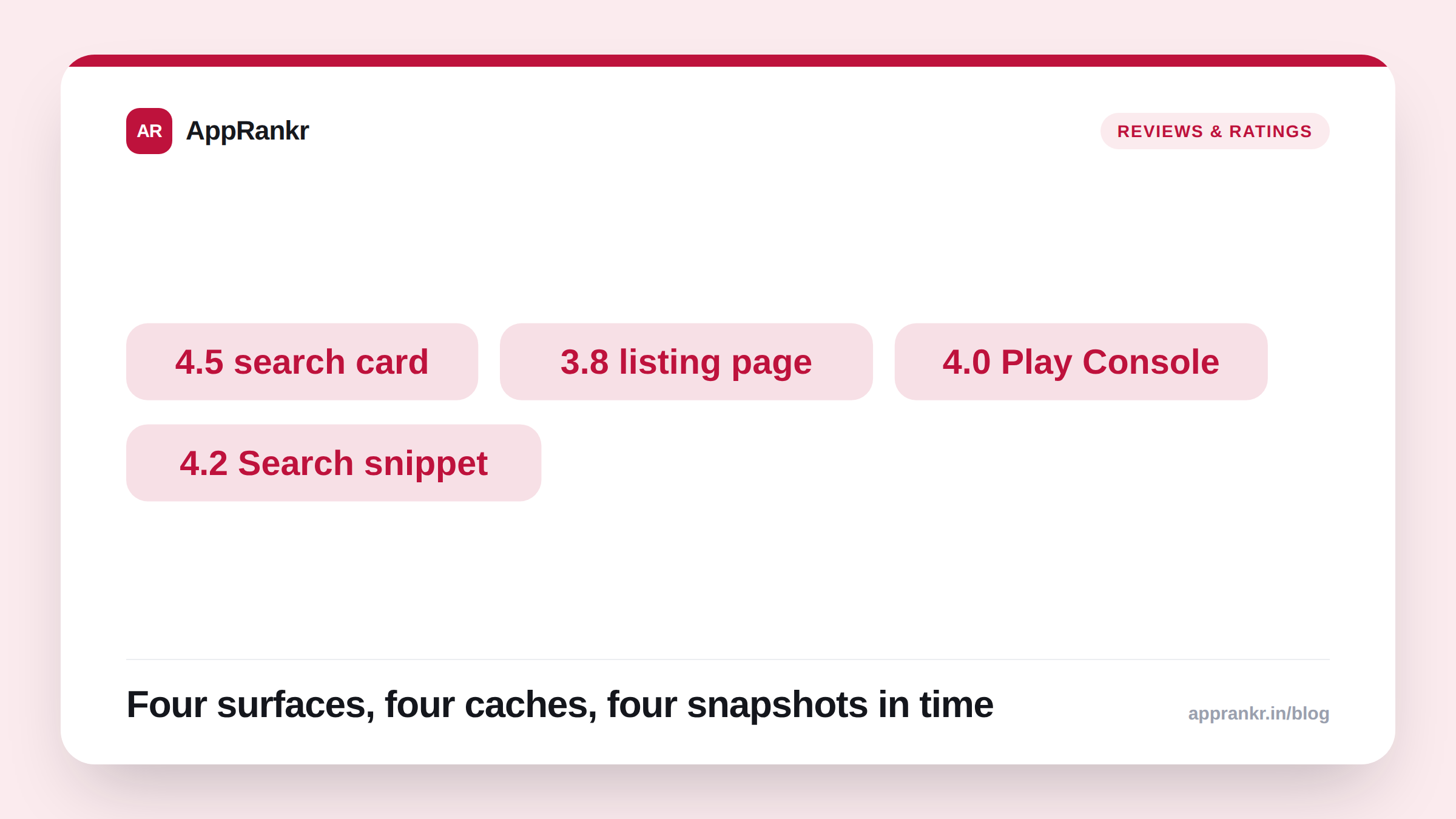
You check your rating on the Google Play search results page: 4.5. You click through to your actual listing: 3.8. You open Play Console to double check: 4.0. Same app, same store, same afternoon, same region. Nothing about your app changed between those three clicks. It’s an unsettling thing to see, and the instinct is to assume something’s broken, or worse, being tampered with. It isn’t. You’re looking at three different systems, each showing you its own cached snapshot of the same underlying number, refreshed on three different schedules.
You’re not looking at one number. You’re looking at several caches of it.
A store the size of Google Play doesn’t recompute and freshly render your rating on every single page load, for every visitor, worldwide, in real time. That would be enormous, unnecessary load for a number that changes slowly. Instead, different surfaces each cache their own version and refresh it on their own cycle:
| Where you looked | What it’s actually showing you | How it refreshes |
|---|---|---|
| Google Play search results (the card) | A cached snapshot from Play’s search index | Its own refresh cycle, independent of your live listing |
| Your app’s full store listing page | The listing page’s own cached render | A separate cache layer from the search card above |
| Play Console (your dashboard) | The value computed directly from Google’s ratings data | Closest to current, but still not instantaneous |
| A Google Search result for your app name | A snippet from Google Search’s own index, not Play’s | Refreshed on Search’s own crawl schedule, which can lag by days |
Right after your underlying rating genuinely shifts, even slightly, these surfaces catch up at different speeds. Two clicks five minutes apart, one through search and one through a direct listing link, can legitimately land on two different cached moments in that catch-up window.
A real, small swing can look like a bigger discrepancy than it is
If your rating pool is modest in size, a real underlying move, say 3.95 drifting to 4.02, can straddle a rounding boundary. One cached surface displays it as “4.0,” another (refreshed a day earlier, at 3.97) still shows “3.9” or rounds down to “3.8” depending on how that surface handles display precision. Stack that rounding effect on top of the caching-lag effect above, and three genuinely different-looking numbers stop being mysterious, they’re a real (small) underlying number, sampled at three different moments, each rounded independently.
Real-world scenario: A productivity app’s owner checked their rating three times over one afternoon: 4.5 from a search result card, 3.8 on the direct listing page opened from a link a user had sent them, and 4.0 in Play Console. Convinced something was wrong, they nearly filed a support ticket over suspected review manipulation. Nothing was wrong. The three numbers were snapshots from three different cache-refresh windows around a real, recent, modest rating shift, and the Play Console figure, the one closest to the live computed value, was the one that actually mattered.
The region angle, and why it’s usually not the explanation here
Google Play can legitimately show different ratings for different countries or storefronts in some markets, ranking and review data can genuinely vary market to market. But that’s a persistent, structural difference tied to where the viewer is, not a same-day, same-region flicker between numbers. If what you’re seeing holds steady for one specific country over time but differs from another country, that’s the regional-data explanation. If it’s the same viewer, same region, changing between refreshes within a day, that’s caching, not localization.
What to actually do
- Trust Play Console’s number when you need the current value, not whichever public surface happens to be open. It’s the one reading closest to the live, actual computation.
- Track it with one consistent method, sampled the same way every time, rather than manually comparing whichever surfaces you happen to glance at. A daily check at a fixed time removes the cache-timing noise entirely from your own record.
- Give a real change a day to propagate before treating a gap between surfaces as a problem. Same-day, same-region differences that close within 24-48 hours are ordinary refresh lag, not something to escalate.
- Don’t read any single glance as the trend — a rating is a moving average, not a fixed fact, and the surface you happen to check first isn’t guaranteed to be the freshest one available.
The number itself is fine. What you’re actually seeing is the ordinary cost of running a store at Google Play’s scale: several caches of the same truth, each a little behind the others, all catching up to a value that was never going to hold perfectly still in the first place.