Key points:
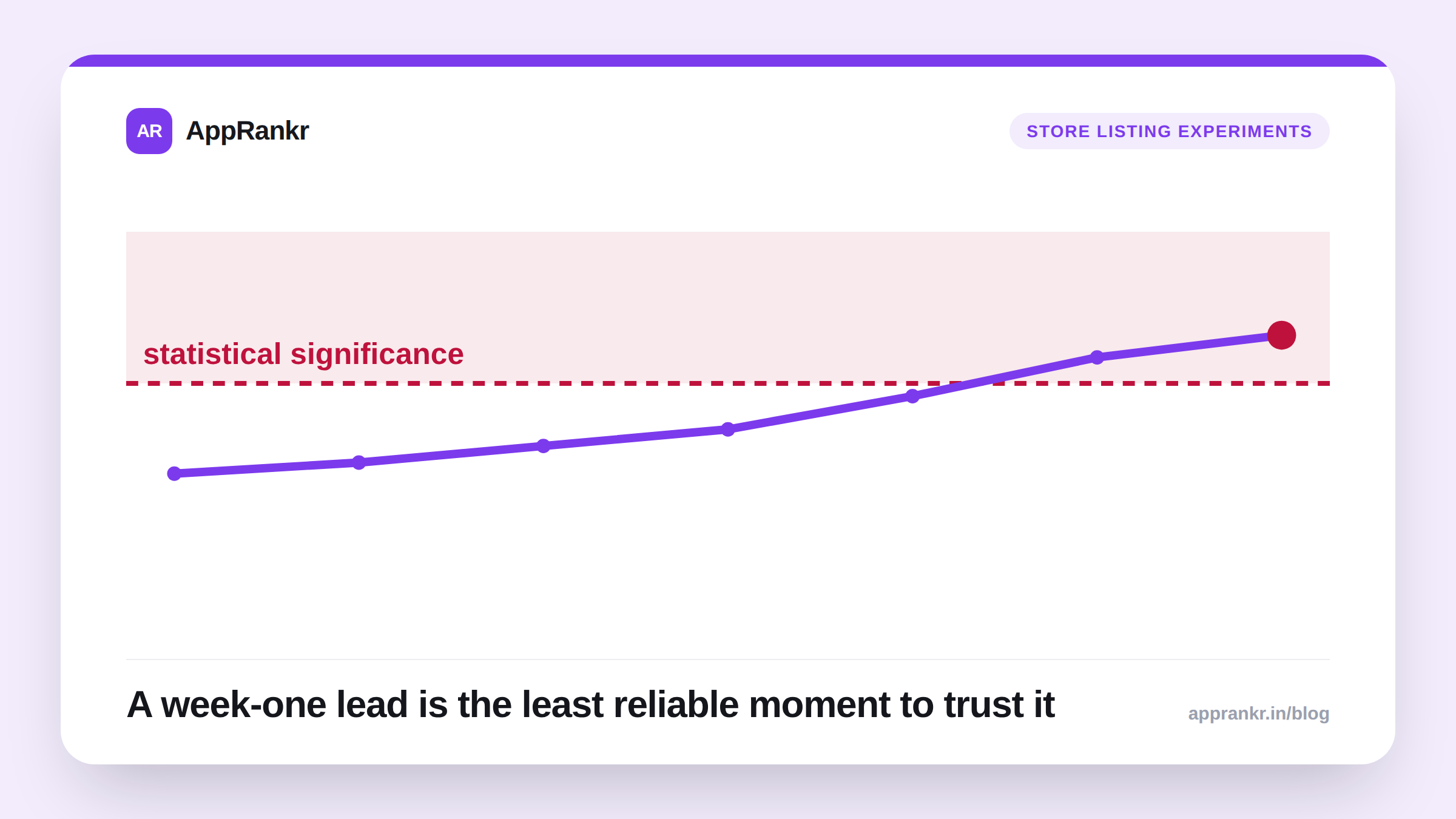
- A positive result in week one is common. It’s also the least reliable moment to trust it.
- Reported guidance and Play Console’s own tools agree: run until statistical significance, not until you like what you see.
- Play Console estimates your experiment’s needed duration based on your app’s own real traffic. That’s a better number than any fixed rule.
- Stopping early on a good-looking early lift is the single most common mistake in store listing experiments.
You started a store listing experiment. A week in, one variant looks like the clear winner. Apply it now, or wait? This is the exact moment most experiments get misread.
Why a week-one lead isn’t the answer yet
Early results run on small sample sizes. Small samples swing hard. A variant can look up 20% on day 4 and land at a real 3% by day 20, once more visitors have actually seen it. That’s not a bug. It’s just what small numbers do before they settle.
Play Console tracks this with a confidence score, not just a raw percentage. A lift with low confidence means the tool itself isn’t ready to call it real yet. Reported guidance across ASO tools converges on the same range: 7 to 14 days as a rough floor, longer if your app gets less daily traffic.
| Signal | What it tells you |
|---|---|
| Early lift, low confidence | Too soon. Don’t apply yet. |
| Lift holds past 7 to 14 days | Getting more trustworthy |
| Play Console marks it significant | Safe to apply |
| Confidence stays low after weeks | App may need more traffic first |
What “Google concludes it” actually means
Play Console doesn’t hand you a fixed end date. It estimates how long your specific experiment needs, based on your app’s own real traffic, right on the setup screen. A high-traffic app might reach a real answer in under two weeks. A lower-traffic app can need a month or more for the same confidence level. That estimate matters more than any generic rule you’ll read anywhere, this post included.
Real-world scenario: A team running a new icon test saw a variant pull ahead by a wide margin after just five days. They almost applied it immediately. Instead, they checked Play Console’s own confidence indicator, which still read low. They let it run another ten days. The lead shrank from a big early gap to a much smaller, but statistically real, improvement. Applying it on day five would have meant chasing a number that was mostly noise.
What to actually do about it
- Check confidence, not just the percentage. A big lift with low confidence isn’t a result yet. It’s a preview that can still move.
- Let it run at least one full week, ideally two. Day-of-week traffic patterns alone can create a fake-looking early lead.
- Trust Play Console’s own duration estimate over any blog’s fixed number. It’s built from your app’s actual traffic, not an industry average.
- Don’t restart the clock with mid-test changes. Editing assets while an experiment runs resets what you’ve already collected.
AppRankr’s Rank Tracker tracks how your visibility moves during and after a listing change, so you can see whether a winning variant actually holds up once it goes live.