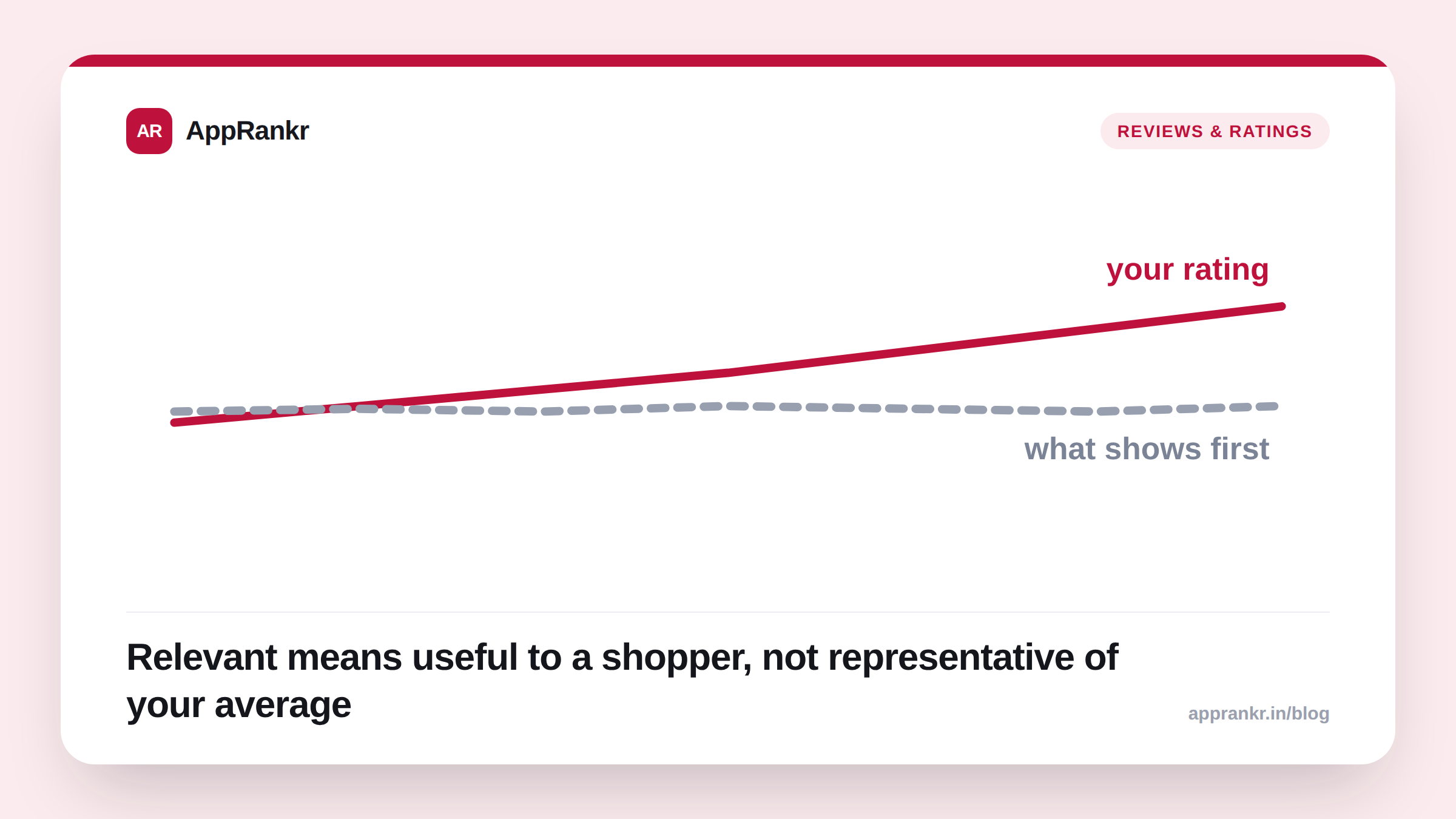
Your average rating reads 4.3. You’ve been getting a steady run of good reviews. And then you open your own Google Play listing to check, and the very first thing under “Ratings and reviews” is a detailed, three-paragraph 1-star complaint. Not the newest review. Not a representative one. The single worst-sounding one on the page, sorted to the top by Google Play’s own default view.
This isn’t a glitch, and it isn’t your rating being buried unfairly. “Most relevant” — the default sort Google Play uses — was never designed to show your average sentiment. It’s designed to show a shopper the review most likely to help them decide, and a detailed complaint often does that job better than a five-word compliment does.
What “Most relevant” is actually sorting by
| Your overall star rating | The review “Most relevant” surfaces first | |
|---|---|---|
| What it represents | The average of every rating and review you’ve ever received | The single review Google’s sort judged most useful to a shopper right now |
| Main inputs | Every star given, weighted across your full history | Helpfulness votes, recency, and other engagement signals on that specific review |
| Rewards | Volume and consistency over time | Specificity and information density in one piece of text |
| A generic “Great app!” | Counts fully toward the average | Contributes almost nothing here — there’s little for a reader to find “helpful” in it |
Google Play lets any reader mark a review “Helpful” with a thumbs-up, and that helpfulness signal, along with recency and other factors, is what the relevance sort is built around. A short five-star review that just says “love it” gives a shopper nothing to evaluate. A detailed one-star review describing a specific bug, a billing surprise, or a missing feature gives them exactly the kind of information they’re looking for before they commit to installing — so it gets marked helpful more often, and rises.
Why this compounds instead of correcting itself
Once a review sits near the top, more people see it. The more people who see it, the more people who are even in a position to mark it helpful. That’s a rich-get-richer loop: an early lead in helpfulness votes tends to entrench itself, not average out, because visibility and helpfulness votes feed each other. A single well-written negative review from months ago can plausibly outrank dozens of newer five-star ones for exactly this reason, independent of whether your overall sentiment has genuinely improved since then.
Real-world scenario: A budgeting app held a steady 4.4 average with hundreds of new five-star reviews arriving monthly. Its “Most relevant” review, unchanged for over two months, was a detailed 1-star complaint about a sync bug that had actually been fixed three releases ago. The team’s own conversion rate lagged their category average despite the healthy rating, because every visitor’s first impression was a bug report the app no longer had.
This is a conversion problem before it’s a ranking problem
Nothing here is a documented, direct ranking-algorithm factor the way keyword relevance or crash rate is. What it affects first is conversion: a shopper who opens your listing, reads a detailed complaint at the top, and leaves without installing. But conversion is widely believed to feed back into rank over time through the same install-and-engagement pathway ranking already responds to — so a listing that quietly under-converts because of what’s pinned to the top isn’t purely cosmetic, it’s a lever with a delayed, indirect effect on the number you actually care about.
What to actually do
- Check what’s actually shown as “Most relevant,” not just your average — an ASO audit surfaces this alongside the rest of your listing, since it’s easy to never look at your own page the way a new visitor does.
- Reply publicly to the review that’s currently on top, especially if the issue is already fixed. The response is visible immediately, regardless of what the sort does next.
- Ask satisfied users for a specific, detailed review, not just a rating. A review that actually says something has a real shot at earning helpful votes over time; “great app!” never will.
- Watch review health as a trend, not a single glance — see how a rating swing actually behaves over time, since the top-sorted review can lag well behind where your real sentiment currently stands.
The number on your listing and the words a visitor actually reads are two different signals, judged by two different systems. A healthy average doesn’t guarantee a healthy first impression, and it’s the first impression that decides whether that visitor ever becomes one of your ratings at all.